
DEEP DIVES
GEOGRAPHY
ECONOMY
ENVIRONMENT
SCIENCE
POLITY
INT RELATIONS
Earthquakes are among the most powerful natural hazards on Earth. Within a few seconds, they can collapse buildings, destroy infrastructure, trigger landslides and tsunamis, and affect millions of people.
Yet the most important thing to understand about earthquakes is this: Earthquakes do not kill people. Unsafe buildings do.
The ground shaking itself is rarely the direct cause of mass casualties. Most deaths occur because buildings collapse, bridges fail, and infrastructure is unable to withstand seismic forces. This distinction is crucial for understanding both disaster management and public policy.
India is particularly vulnerable. Around 61% of India’s land area and 75% of its population now fall within moderate-to-extreme seismic hazard zones, making earthquake preparedness one of India’s most important governance challenges.
What is an Earthquake?
Imagine holding a wooden ruler from both ends and slowly bending it. At first, nothing happens. Pressure keeps building. Then suddenly— SNAP! The ruler breaks and releases all the stored energy at once.
An earthquake works in much the same way. The Earth’s outer surface is not a single solid shell. It is broken into giant pieces called tectonic plates. These plates move constantly, although very slowly. Sometimes they become stuck because of friction. Even though they stop moving, pressure continues to build. Eventually the rocks can no longer withstand the stress. They suddenly break. The stored energy is released. That release of energy is an earthquake.
Why do Earthquakes occur?
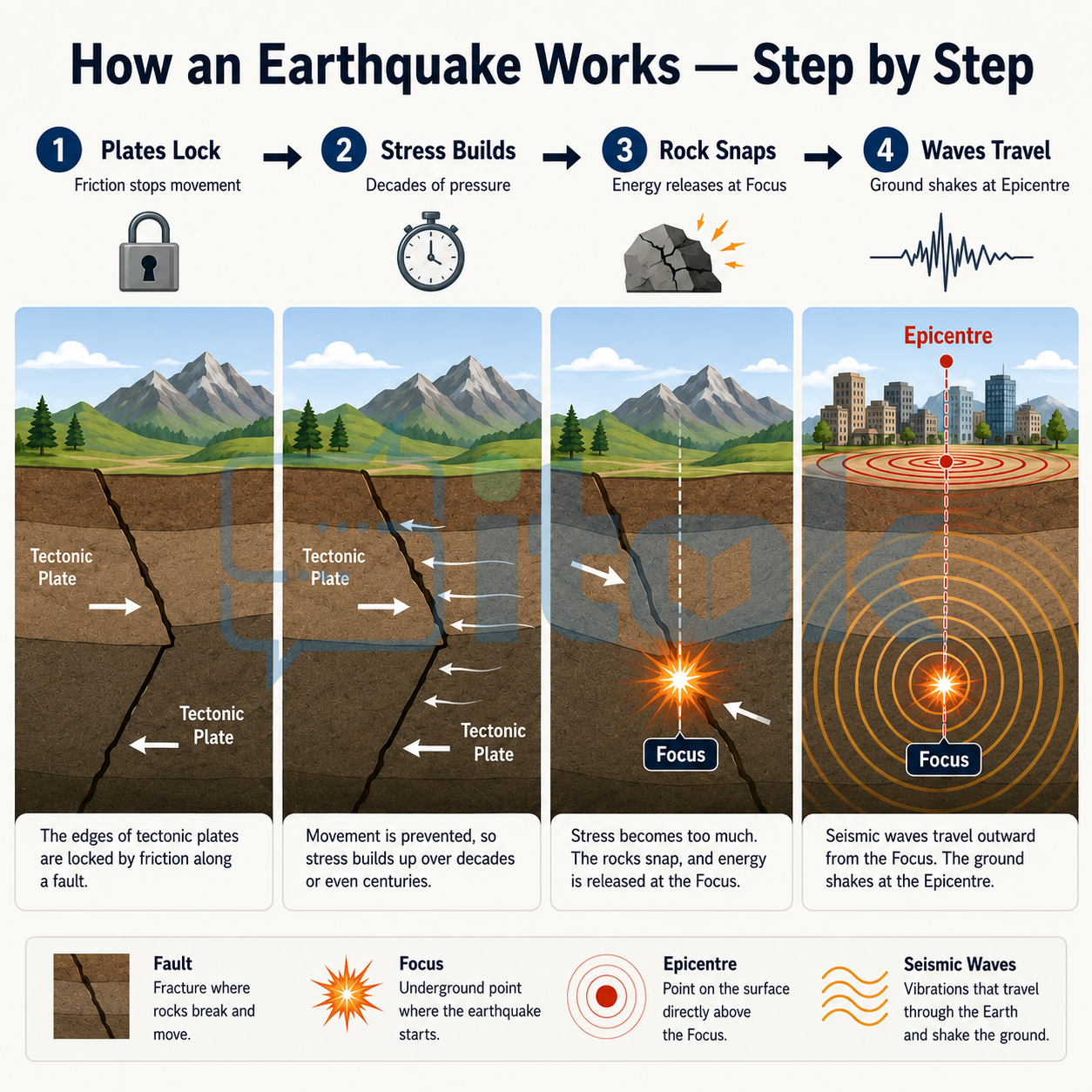
Think of it as a four-step process:
Step 1: Plates Lock :The edges of tectonic plates become stuck because of friction.
Step 2: Stress Builds: Pressure accumulates over years, decades, or even centuries.
Step 3: Rock Snaps: The rocks finally break when the pressure becomes too great.
Step 4: Waves Travel: Energy travels outward through the ground as seismic waves, causing the shaking we feel.
Convergent Boundary
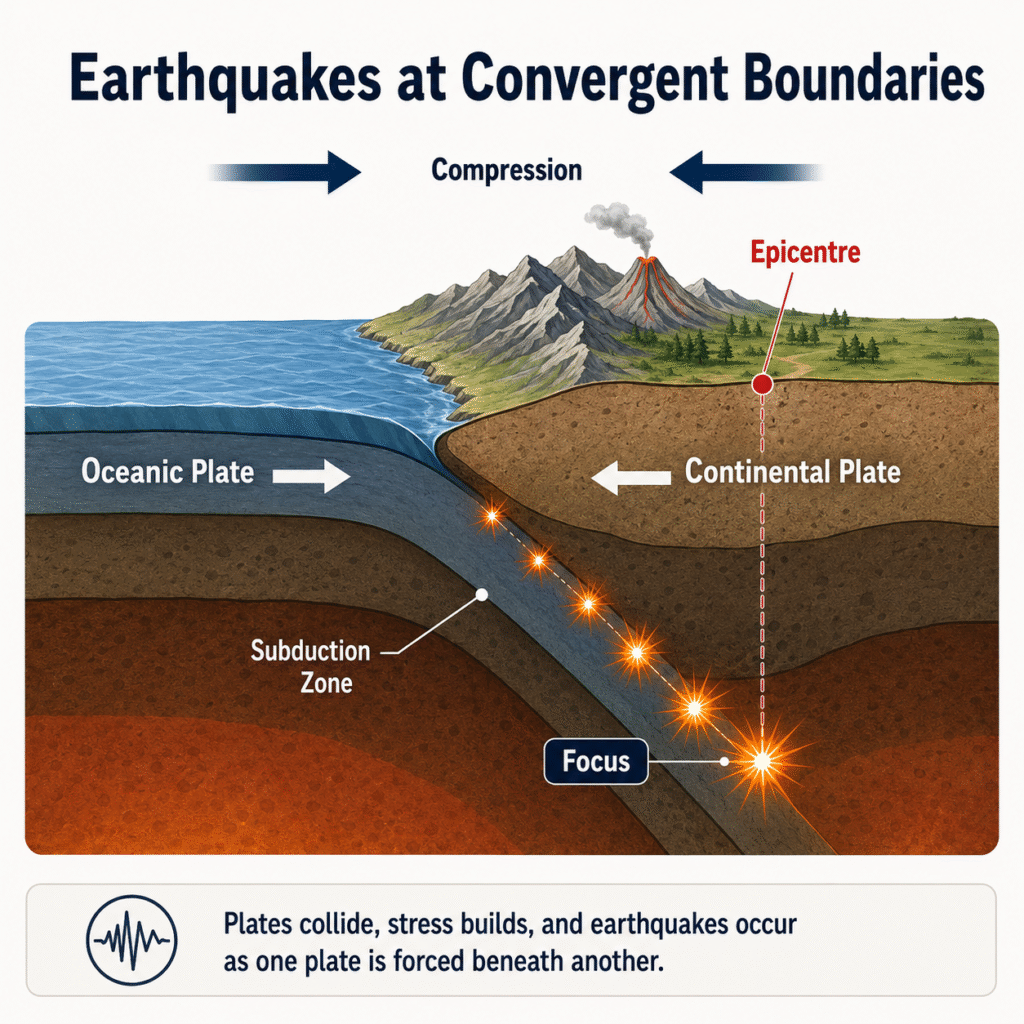
Imagine two cars driving directly toward each other. Eventually something has to give way.
At convergent boundaries, tectonic plates move toward each other. One plate may be forced beneath another in a process known as subduction. These boundaries produce the world’s most powerful earthquakes.
Example: The Himalayas exist because the Indian Plate continues to push into the Eurasian Plate. The same collision is responsible for major earthquakes across the Himalayan region.
Divergent Boundary
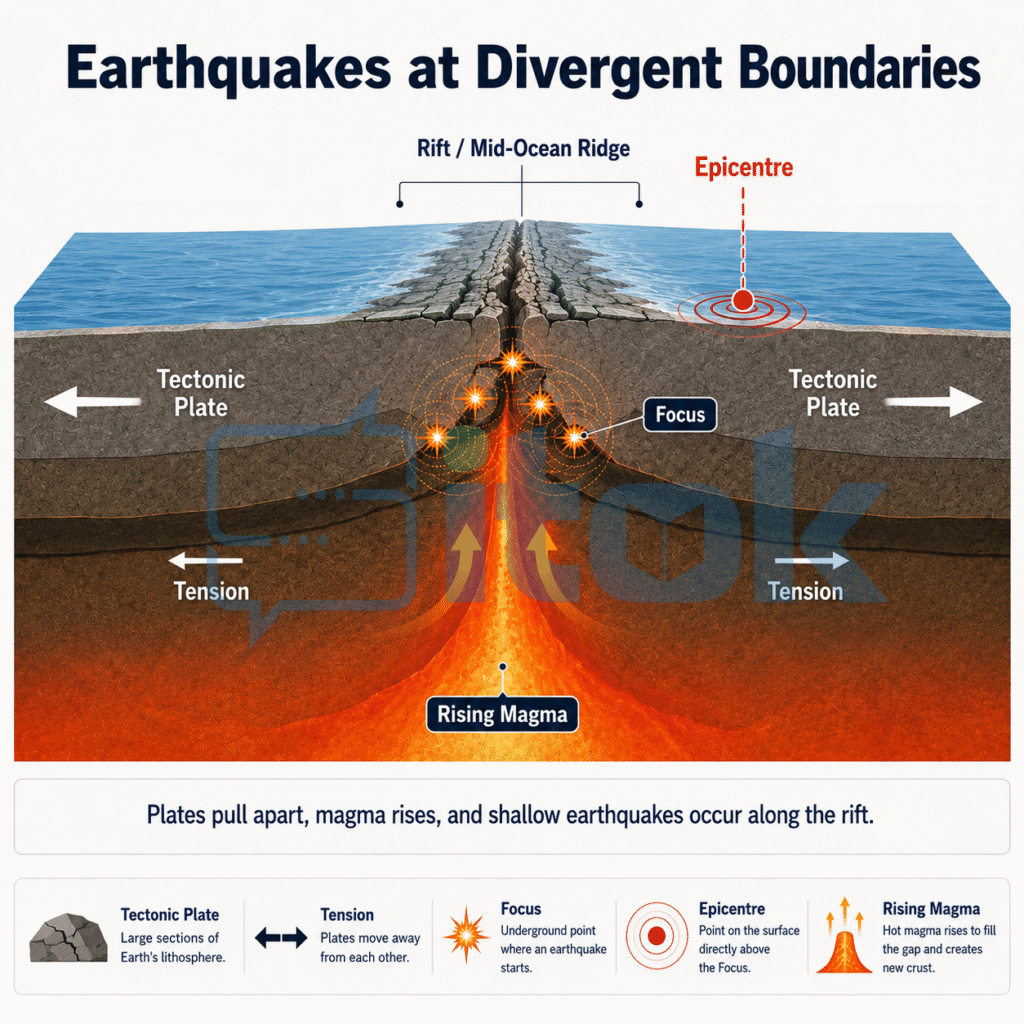
Imagine pulling apart a piece of bread. A gap opens.
At divergent boundaries, plates move away from each other.
Magma rises to fill the gap, creating new crust and causing frequent but generally smaller earthquakes.
Example: The Mid-Atlantic Ridge is the world’s most famous divergent boundary. Iceland sits directly on this ridge.
Transform Boundary
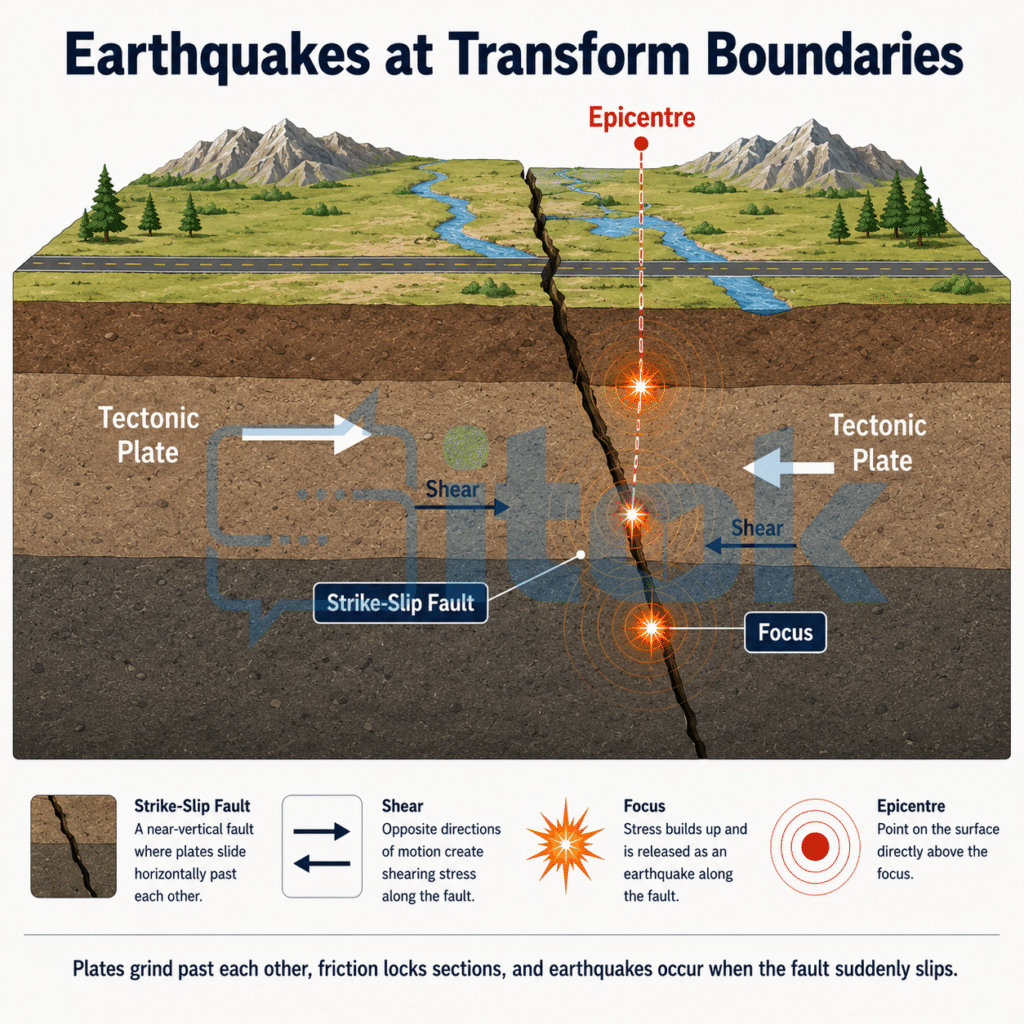
Imagine rubbing your palms together while pushing them in opposite directions. They stick. Pressure builds. Suddenly they slip.
That sudden movement resembles a transform boundary. Here, plates slide horizontally past each other.
Example: California’s famous San Andreas Fault is a transform boundary.
Where do most Earthquakes occur?
Earthquakes are not randomly distributed. They tend to occur along tectonic plate boundaries. Three major seismic belts dominate the world.
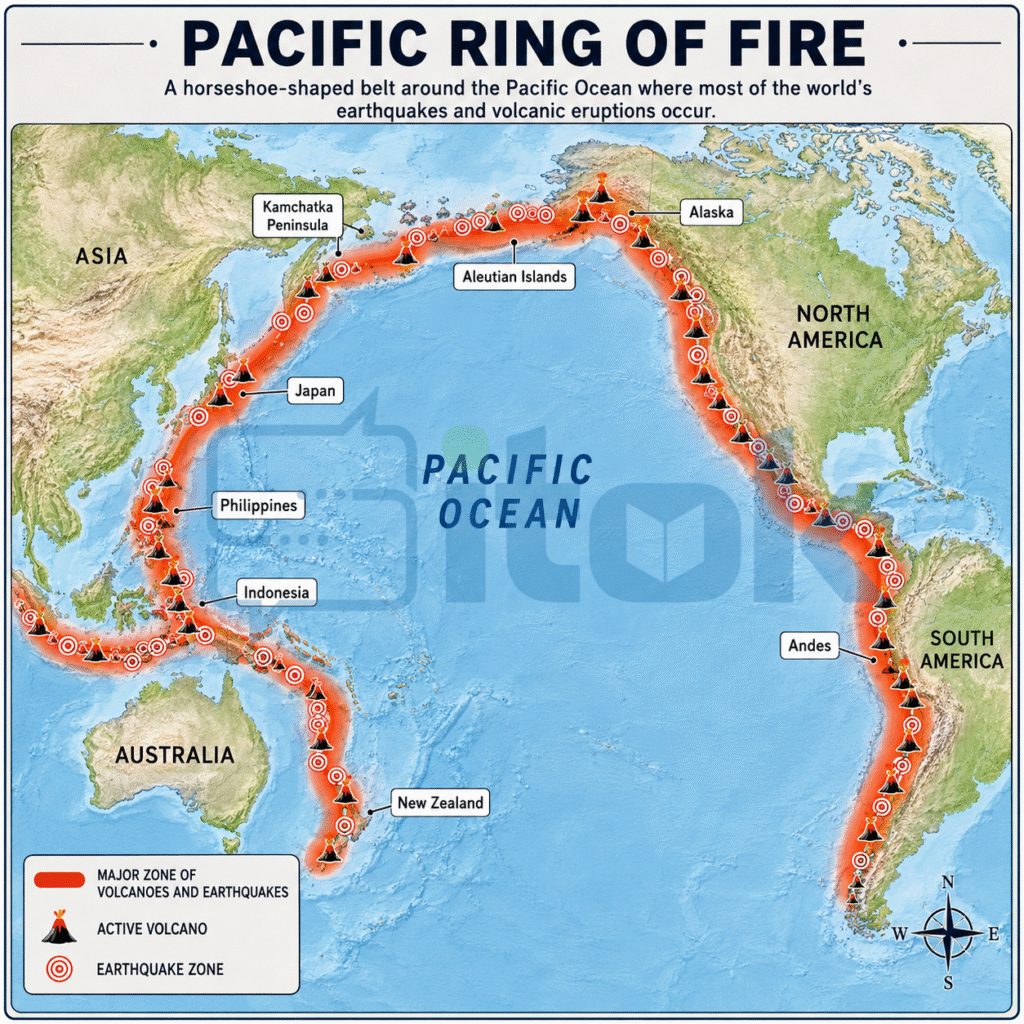
Ring of Fire
Imagine a giant horseshoe encircling the Pacific Ocean. This is the Pacific Ring of Fire.
It contains about 81% of the world’s largest earthquakes and many of the world’s active volcanoes.
Countries located here include:
- Japan
- Indonesia
- Chile
- Philippines
- New Zealand
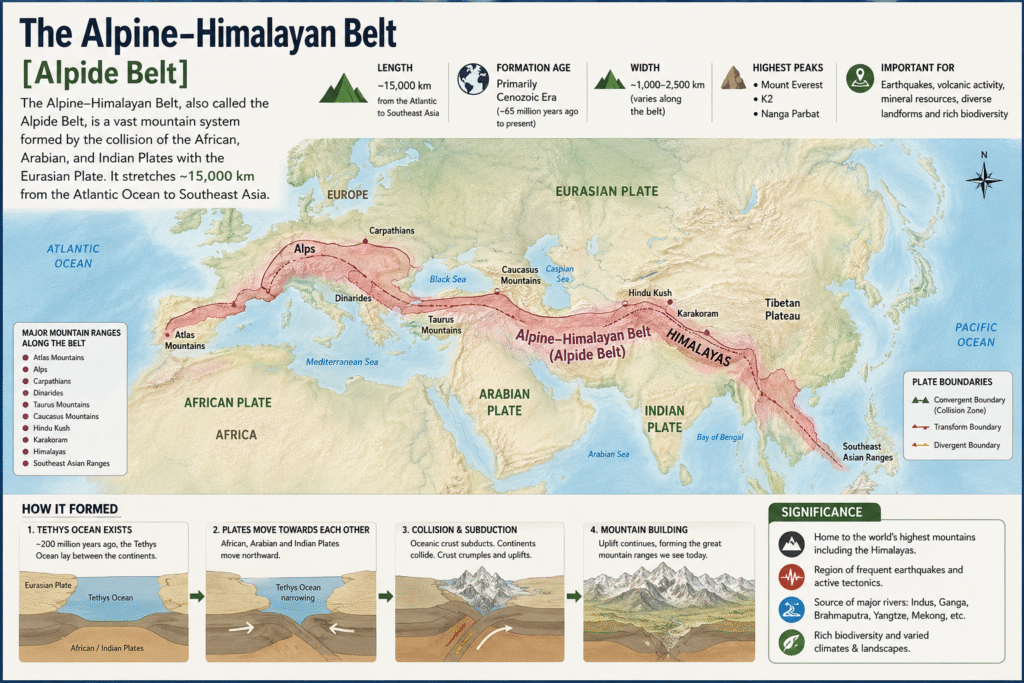
Alpine Himalayan Belt
This belt stretches from the Mediterranean region through Turkey, Iran, and the Himalayas into Southeast Asia. India lies entirely within this belt.
This is one of the main reasons earthquakes remain a major concern for the country.
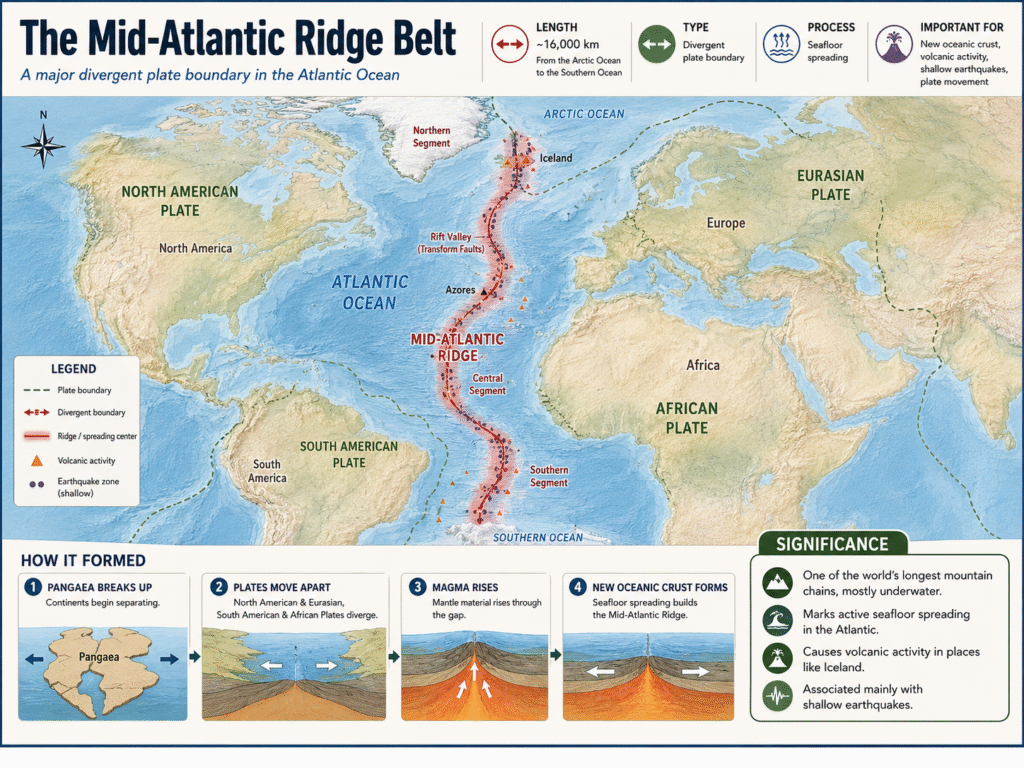
Mid Atlantic Ridge
This underwater mountain chain runs through the Atlantic Ocean.
Because most of it is submerged, its earthquakes rarely affect large populations.
Why is India so vulnerable?
Imagine two giant trucks slowly colliding. The collision may take millions of years, but the pressure never stops building. India sits on the Indian Plate, which continues to move northward and push against the Eurasian Plate. This ongoing collision created the Himalayas. It also creates continuous seismic stress. As a result, the Himalayan region remains one of the most earthquake-prone areas in the world.
India's new seismic zones [IS1893:2025]
In 2025, India revised its seismic zoning system under IS 1893:2025. The most significant change was the introduction of:
Zone VI (New): The highest-risk category. Includes much of the Himalayan arc. Designed for earthquakes exceeding magnitude 8. Other zones range from:
Zone V (Very High Risk)
Zone IV (High Risk)
Zone III (Moderate Risk)
Zone II (Low Risk)
The revised map places 61% of India’s land area and 75% of its population in moderate-to-extreme seismic hazard zones.
The Real Problem: Why Earthquakes kill
Most people think earthquake disasters are caused by the earthquake itself. That is only partially true.
Imagine two cities experience the same magnitude 7 earthquake. City A has earthquake-resistant buildings. City B has poorly constructed buildings. The earthquake is identical. The outcome is completely different. This is why disaster experts increasingly argue: The earthquake is a natural hazard. The disaster is often a governance failure.
India’s biggest challenge is not predicting earthquakes. It is ensuring that buildings, bridges, hospitals, schools, and infrastructure are built to survive them.
How does India manage Earthquakes?
India follows a three-tier disaster management system.
National Level: National Disaster Management Authority (NDMA)- Chaired by the Prime Minister.
State Level: State Disaster Management Authority (SDMA)- Chaired by the Chief Minister.
District Level: District Disaster Management Authority (DDMA)- Led by the District Magistrate.
Supporting institutions include: NDRF | NIDM | National Centre for Seismology (NCS)
Conclusion
Earthquakes are unavoidable. Disasters are not. India cannot stop tectonic plates from moving, nor can it predict exactly when the next major earthquake will occur. But it can strengthen buildings, enforce safety standards, improve preparedness, and create resilient cities. The real test for India is not whether the Earth shakes. It is whether our systems are ready when it does.
The Super El Niño of 2026 is one of the most powerful climate events in recent history, causing extreme weather disruptions across the globe. It is essentially a massive warming of the Pacific Ocean that alters rainfall, temperature patterns, agriculture, and global economic systems.
While El Niño is a natural phenomenon, the 2026 event is being intensified by climate change, making it far more disruptive than usual.
What is Super El Nino?
Super El Niño is an extreme version of the El Niño phenomenon, where sea surface temperatures in the central and eastern Pacific Ocean rise significantly above normal.
Simple idea:
Pacific Ocean = giant bathtub
Normal → warm water stays near Asia
El Niño → warm water moves east
Super El Niño → extreme shift + global disruption.
El Nino
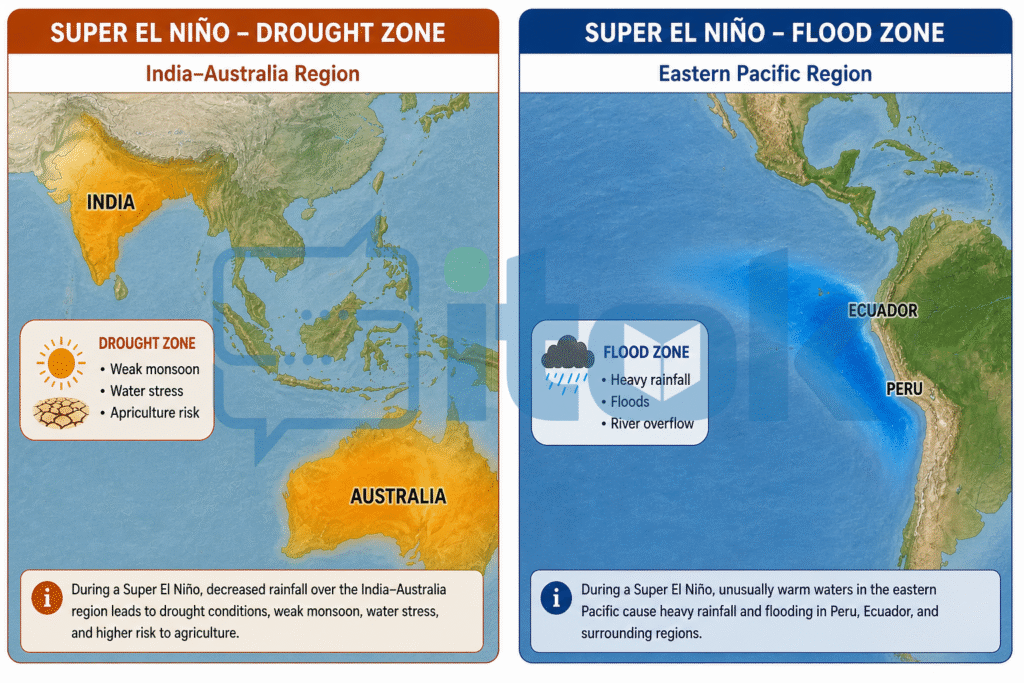
Imagine the Pacific Ocean like a big bathtub. Normally, all the warm water stays on one side—near countries like India and Australia. But sometimes, this warm water slowly slides to the other side, toward South America.
Now think of clouds like people who follow warm water. Wherever the warm water goes, clouds go there too.
So when the warm water moves to South America, the clouds also go there. That means those areas get a lot of rain—sometimes too much, causing floods. But places like India are left with fewer clouds, so rainfall reduces, and the monsoon becomes weak.
So in simple terms:
Warm water runs away from India → clouds follow → India gets less rain.
La Nina
Now imagine the opposite situation. This time, strong winds act like a powerful fan, pushing all the warm water toward Asia—toward India and Australia.
Again, clouds follow the warm water. So now, more clouds gather over India.
This means India gets good rainfall, sometimes even heavy rainfall. But since the warm water has moved away from South America, those regions don’t get much rain and can face drought.
So in simple terms:
Warm water comes closer to India → clouds come with it → India gets good rain.
Neutral Condition
Now imagine the bathtub is perfectly balanced. The warm water stays where it should, and the winds blow normally—not too strong, not too weak.
Because everything is balanced, clouds also behave normally. Rainfall happens where it is expected, and weather patterns remain stable.
So in simple terms:
Everything is in balance → no surprises → normal weather.
Super El Nino
Now imagine something extreme happens.
Instead of the warm water slowly moving, it suddenly rushes across the ocean—like someone violently shaking the bathtub. The warm water doesn’t just shift… it overflows toward South America.
At the same time, the winds don’t just weaken—they actually reverse direction. It’s like the fan suddenly starts blowing the wrong way.
Now the clouds go completely out of control:
- South America gets massive floods
- India and Australia face severe drought
- The whole planet heats up more than usual
It’s not just a weather change anymore—it becomes a global disruption affecting food, water, economy, and health.
In simple words:
Warm water rushes away violently → clouds go crazy → extreme weather everywhere.
Why is Super El Nino Dangerous?
This event is not just natural — it is amplified by global warming.
- Adds to already rising global temperatures
- Pushes planet toward climate thresholds
- Triggers simultaneous extreme events worldwide
Agriculture
- Weak Indian monsoon (~92% of normal rainfall)
- Kharif crops (rice, pulses) at risk.
- Soil moisture decline
Inflation
- Food shortages → price rise
- CPI inflation increases
- RBI forced to maintain higher interest rates
Public Health Crisis
- Extreme heatwaves
- Wet-bulb temperature approaching survival limits
- Increase in heatstroke cases
Energy Crisis
- High electricity demand (cooling)
- Reduced hydropower
- Power shortages
Union Budget 2026–27 Explained for UPSC
Sector-Wise Analysis | Fiscal Deficit | Capex Strategy | The 3 Kartavyas
The Union Budget 2026–27 is built around one simple idea: grow the economy, but do it responsibly. The government plans to reduce its fiscal deficit to 4.3% of GDP while increasing capital expenditure to ₹12.2 lakh crore for long-term development.
For UPSC preparation, this Budget is not just about memorising figures — it reveals the larger policy direction of the government.
What is the Union Budget? (Constitutional Basis)
Under Article 112 of the Constitution, the Union Budget is formally known as the Annual Financial Statement (AFS). It outlines:
- Estimated receipts and expenditures
- Fiscal deficit targets
- Sectoral allocations
- Borrowing strategy
- Tax proposals
Understanding this constitutional foundation is essential for GS-II and Polity integration.
Fiscal Deficit, Revenue Deficit & Primary Deficit Explained
Fiscal Deficit: 4.3% of GDP
Fiscal deficit represents the gap between total expenditure and total receipts (excluding borrowings). The 4.3% target signals a gradual move toward fiscal discipline.
Revenue Deficit
Revenue deficit occurs when revenue expenditure exceeds revenue receipts. Lowering this improves fiscal sustainability.
Primary Deficit
Primary deficit = Fiscal deficit minus interest payments. It indicates the current year’s borrowing burden excluding past debt obligations.
Debt-to-GDP Target: 55.6%
The government aims to reduce the debt-to-GDP ratio to 55.6%, indicating long-term consolidation.
3 Kartavyas of Budget 2026-2027
The government framed this budget around three core duties:
Accelerating and Sustaining Economic Growth
Fulfilling Aspirations and Building Capacity
Inclusive Development (Sabka Saath, Sabka Vikas)
This framework shifts from rights-based discourse to responsibility-based governance.
Capital Expenditure Strategy in Union Budget 2026–27
Capital Expenditure (CapEx) refers to government spending that leads to the creation of long-term assets or enhances productive capacity in the economy. Unlike revenue expenditure — which covers salaries, subsidies, and routine administrative expenses — capital expenditure results in tangible infrastructure such as highways, rail corridors, ports, power plants, defence equipment, and digital public infrastructure. In macroeconomic terms, CapEx strengthens the supply side of the economy by expanding its ability to produce goods and services over time.
In the context of the Union Budget 2026–27, the capital expenditure strategy reflects a continued emphasis on infrastructure-led growth. Higher allocation toward railways, logistics, renewable energy, and defence modernisation aims to generate a strong multiplier effect — where each rupee spent stimulates broader economic activity, private investment, and employment. By prioritising CapEx while maintaining fiscal discipline, the government signals a shift toward long-term productivity enhancement rather than short-term consumption-driven growth.
Budget 2026–27 Capex: ₹12.2 lakh crore
Growth Rate: ~11.5% increase
Sector-Wise Analysis of Union Budget 2026–27
Manufacturing & Industry
Key Announcements:
- Biopharma SHAKTI
- Semiconductor Mission 2.0
- Electronics Component Scheme
- Rare Earth Corridors
- ₹10,000 Cr SME Growth Fund
Infrastructure & Transport
- 7 High-Speed Rail Corridors
- Dedicated Freight Corridor
- 20 New National Waterways
- Container Manufacturing Scheme
Logistics cost reduction from 14% toward global average.
Agriculture
- Bharat-VISTAAR (AI-driven advisory)
- High-value crops scheme
- SHE-Marts
Education & Skill Development
- University townships
- District girls hostels
- Caregiver skilling
- AVGC creative economy labs
Health & Mental Wellness
- NIMHANS-2
- 17 cancer drugs duty removal
- 1 lakh allied health professionals
Defence
- ₹7.85 lakh crore outlay
- 75% capital for domestic procurement
- Indigenous aero-engines
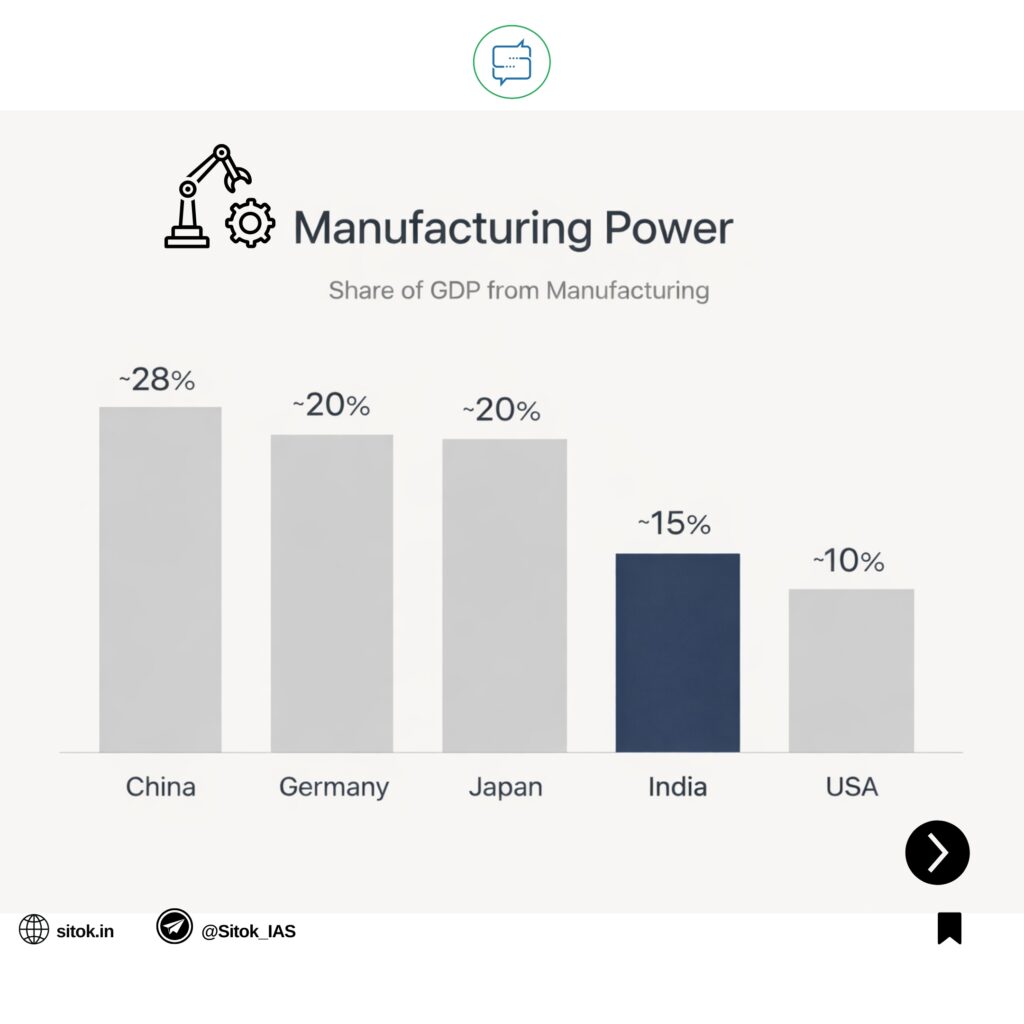
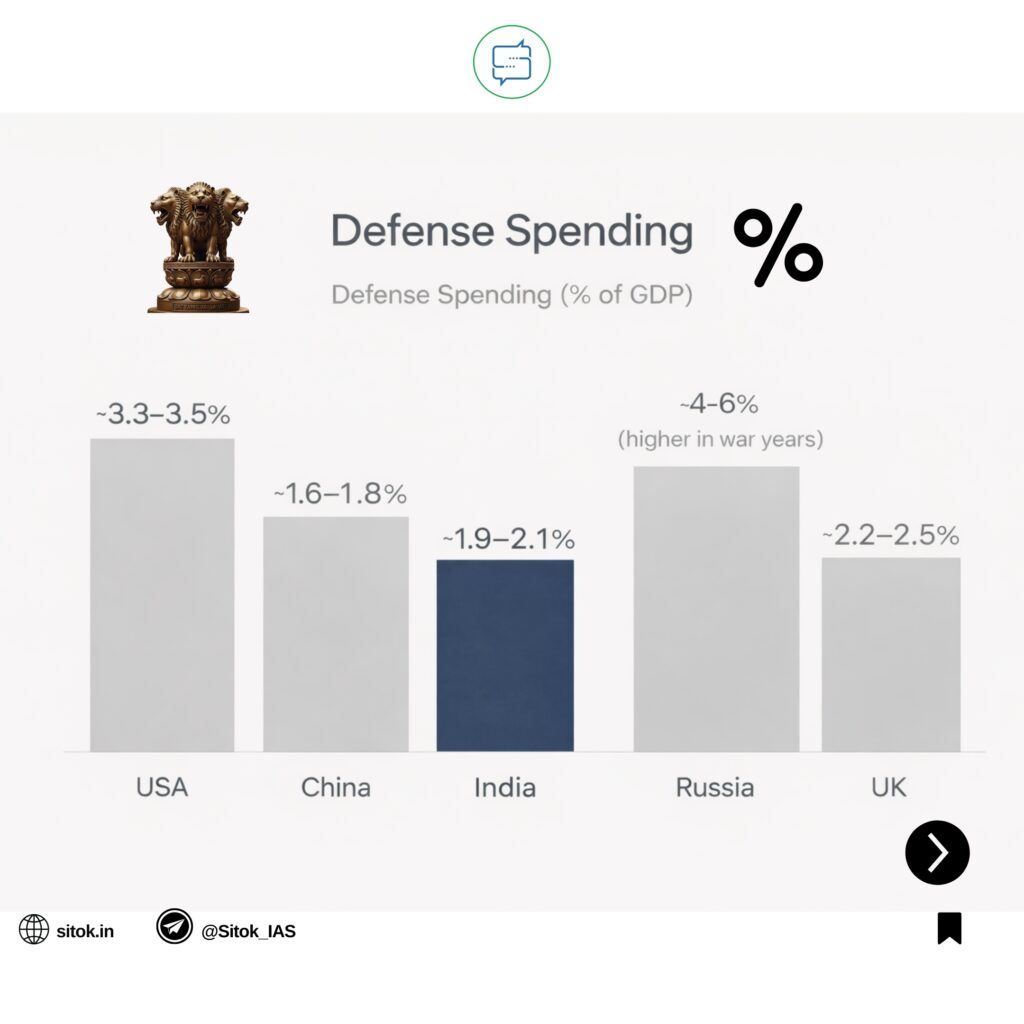
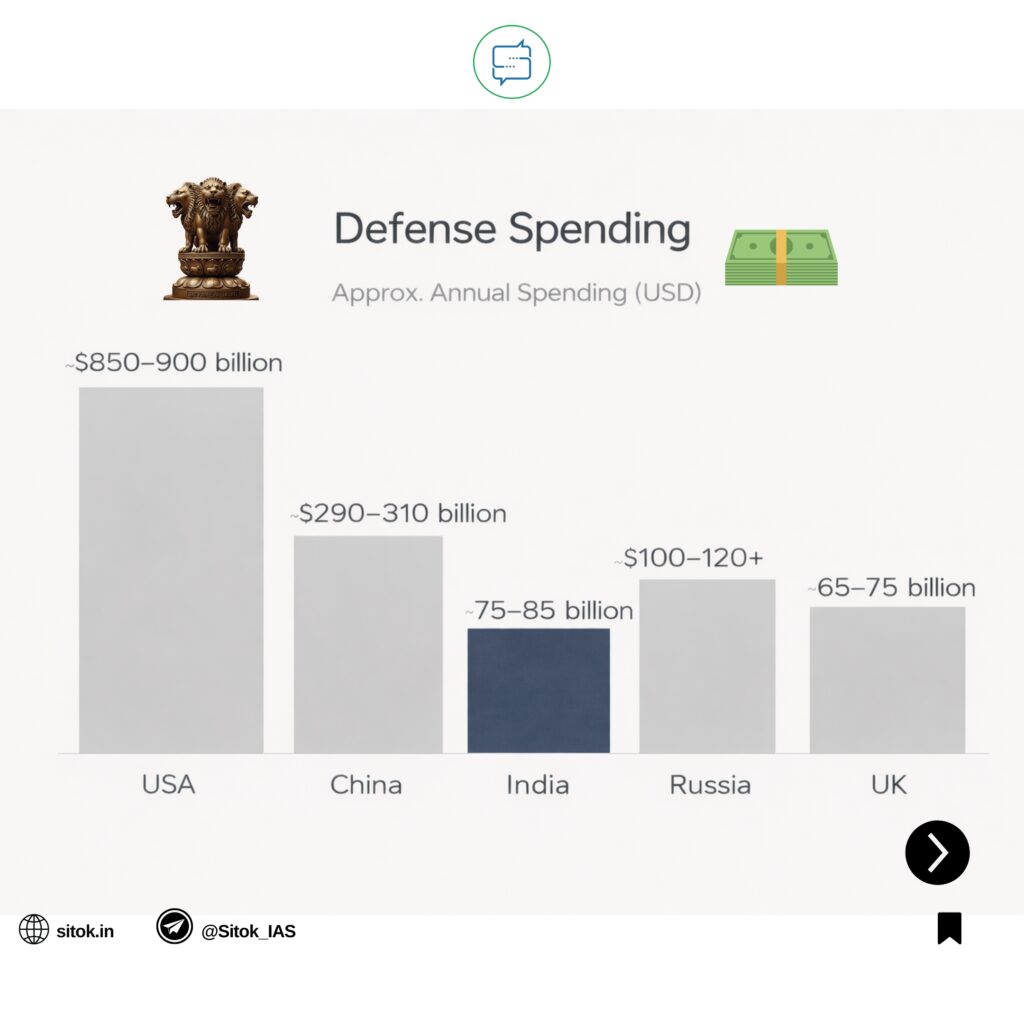
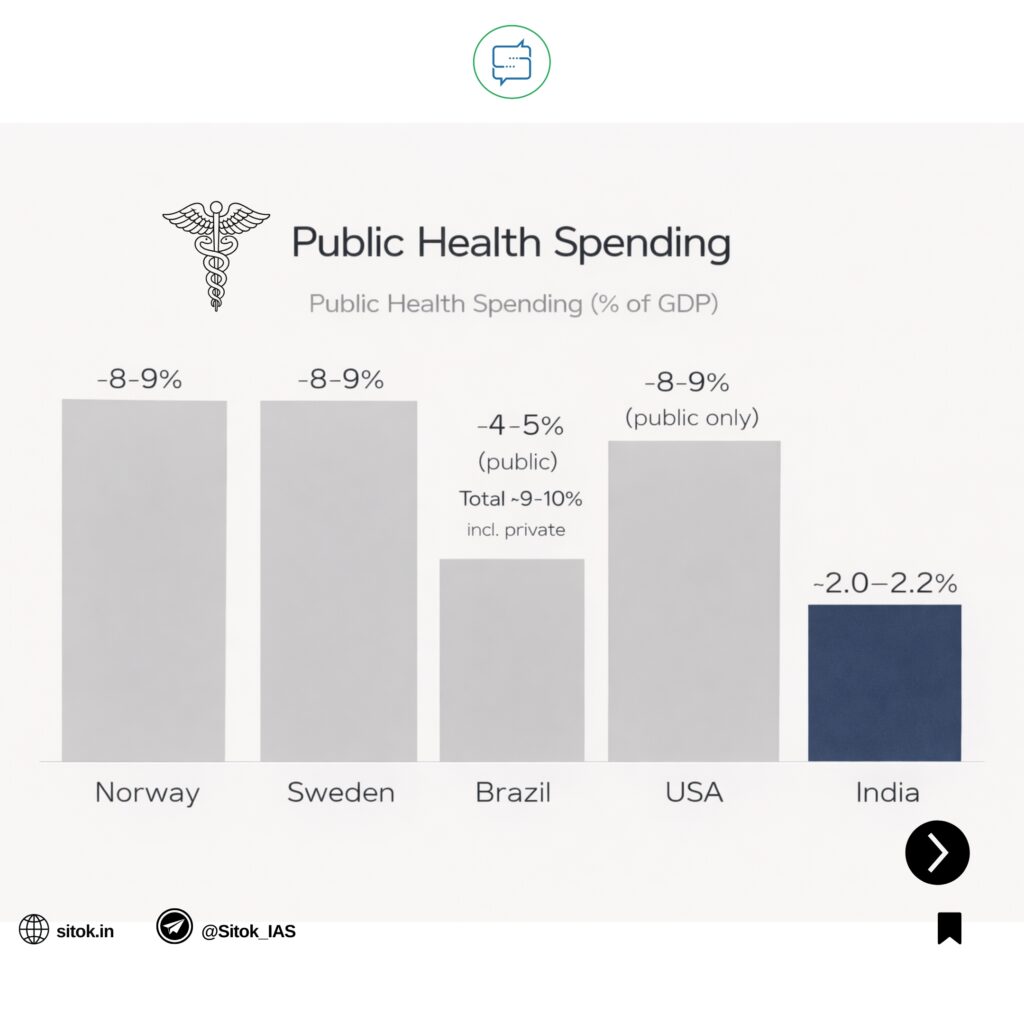
Global Comparisons
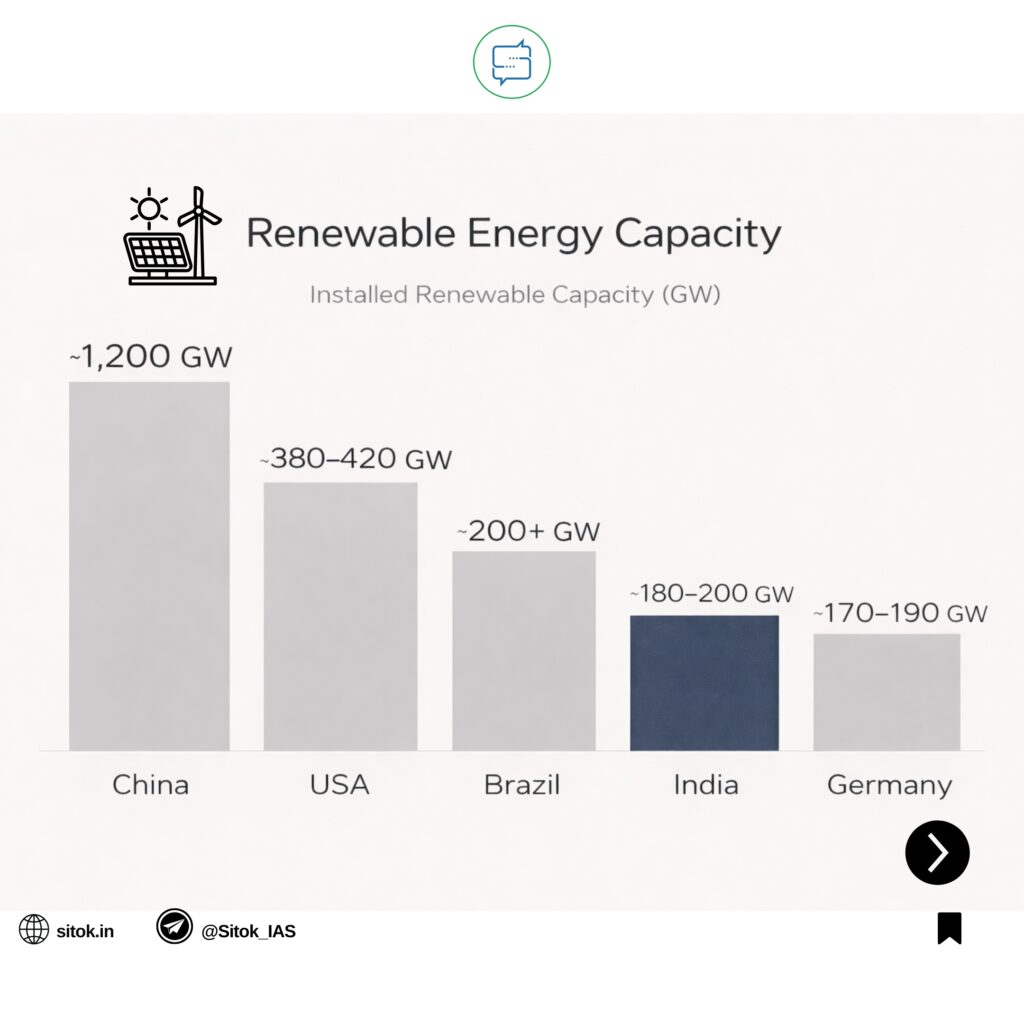
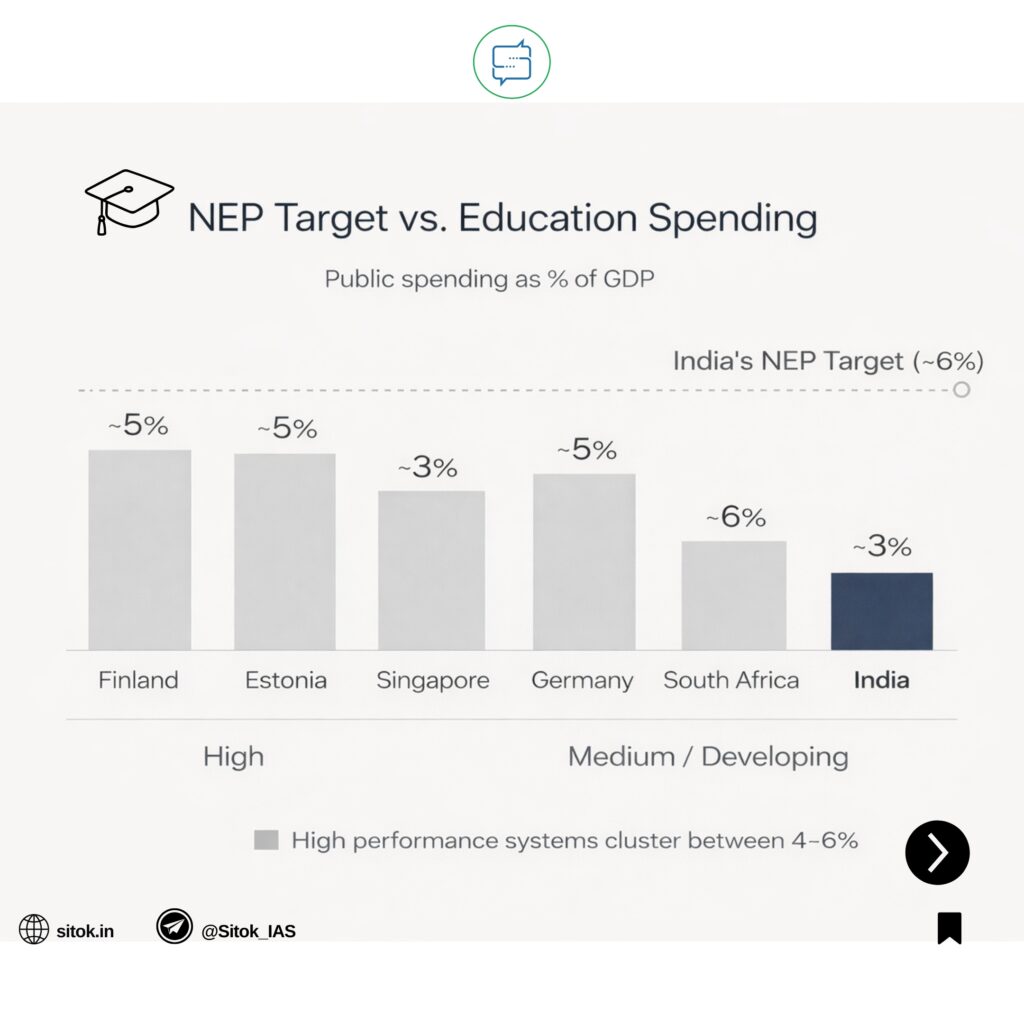
Assam & Arunachal Pradesh Floods 2026
Causes | Brahmaputra | Embankments | Solutions
Assam floods every year. The Brahmaputra rises, embankments breach, villages go underwater, people move into relief camps, governments announce assistance, and damaged embankments are repaired. Then, the next monsoon arrives—and the cycle begins again.
It is tempting to call this an unavoidable natural disaster. After all, Assam lies in the floodplain of one of the world’s most powerful rivers. But that explanation misses the larger problem.
The Brahmaputra flooding is natural. The scale of the disaster is not. The 2026 floods exposed how geography, ageing embankments, disappearing wetlands, fragmented river management and weak interstate coordination can turn a predictable monsoon phenomenon into a recurring humanitarian crisis. Arunachal Pradesh faced a related but very different problem: intense rainfall and landslides repeatedly severed roads and bridges, threatening not only communities but India’s strategic connectivity near the border.
Why does Assam flood every year?
To understand Assam’s floods, first forget the idea of a river as a neat blue line on a map.
The Brahmaputra is not that kind of river. Imagine carrying a huge tray filled with sand and water down a steep staircase. While you’re moving quickly downhill, you can carry everything. But the moment you reach a flat floor and slow down, the sand begins to fall out. Something similar happens to the Brahmaputra.
The river originates in Tibet as the Yarlung Tsangpo and descends dramatically through the Himalayas before entering India. Along the way, it picks up enormous quantities of rock, sand and silt from the young Himalayan mountains. When it reaches the flatter Assam plains, the river slows. It can no longer carry all that sediment. So the sediment settles. Over time, this raises the riverbed, reduces the space available for water, and encourages the river to spread sideways during periods of heavy rainfall.
And that brings us to the first major characteristic of the Brahmaputra.
The Brahmaputra Carries an Extraordinary Amount of Sediment
The Brahmaputra carries approximately 735 million tonnes of sediment every year, placing it among the world’s most sediment-heavy rivers.
Think of the river as a pipe carrying muddy water. If mud continuously settles at the bottom of the pipe, the space available for water becomes smaller and smaller.
Eventually, the same amount of water needs more space. So it spreads outward. That is one reason simply “desilting the Brahmaputra” is not an easy one-time solution. The Himalayas keep producing new sediment every year.
The Brahmaputra Does Not Stay in One Channel
The Brahmaputra is a braided river.
Instead of flowing neatly through one channel, it divides into multiple channels that split, reconnect and shift over time.
Imagine pouring water across a large tray of loose sand. The water will not necessarily follow the same path every time. It creates channels, abandons them, creates new ones and continuously rearranges the sand.
The Brahmaputra behaves similarly—just on an enormous scale. At some stretches, the river has widened to around 15 km, while approximately 2,358 sq km of Assam has already been permanently lost to riverbank erosion.
This creates a fundamental problem:
How do you permanently contain a river whose natural behaviour is to move? That question takes us to Assam’s embankments.
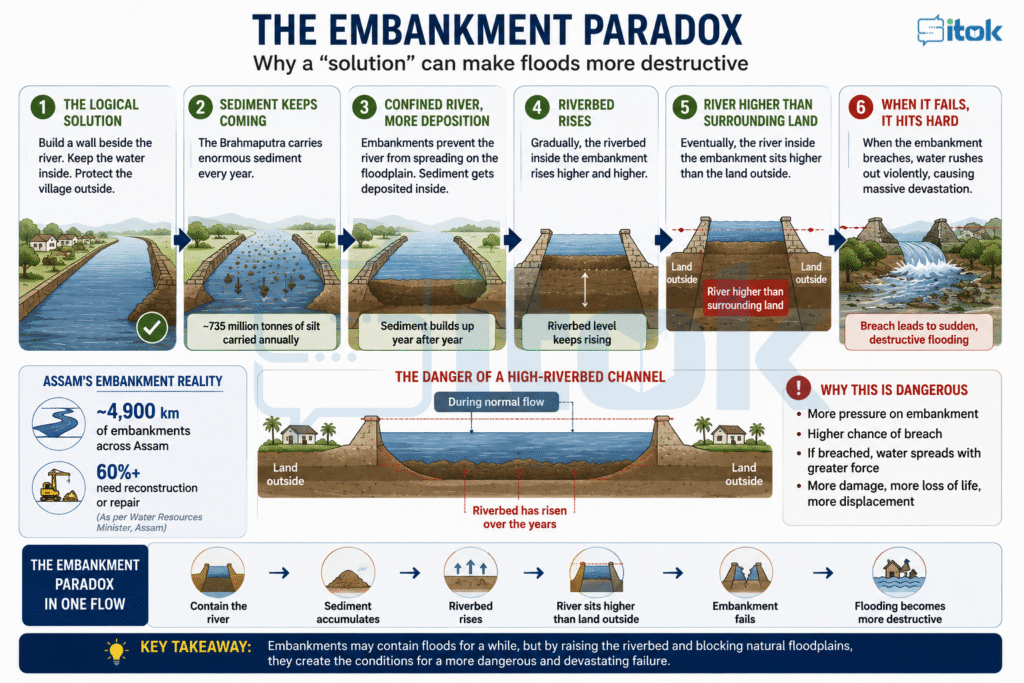
The Embankment Paradox: When the Solution Makes the Problem Worse
An embankment sounds perfectly logical. Build a wall beside the river. Keep the water inside. Protect the village outside.
Simple.
Except the Brahmaputra continues carrying enormous quantities of sediment. When embankments prevent the river from spreading naturally across its floodplain, more sediment gets deposited inside the confined channel. Gradually, the riverbed rises.
Now imagine something strange:
The river inside the embankment can eventually sit higher than the land outside it.
As long as the wall holds, the settlement is protected. But when an ageing or weakened embankment breaches, the water does not simply spread gradually. It can rush outward.
The infrastructure designed to reduce the flood can therefore make the eventual failure more destructive. Assam has roughly 4,900 km of embankments, and the state’s Water Resources Minister has acknowledged that more than 60% require reconstruction or repair.
This is the embankment paradox:
Contain the river → sediment accumulates → riverbed rises → embankment fails → flooding becomes more destructive.
What was different about the Assam floods of 2026?
This is perhaps the most important part of the 2026 story. The Brahmaputra itself was not initially the main culprit.
Heavy upstream rainfall in Nagaland and Arunachal Pradesh caused several south-bank tributaries—including the Dikhow, Disang, Janji and Dhansiri—to swell rapidly. These tributaries crossed danger levels and flooded parts of Assam before the Brahmaputra itself reached peak discharge.
Imagine the Brahmaputra as the main highway. India has spent decades watching traffic on that highway. But in 2026, the traffic jam came rushing in through the side roads. That exposed a major weakness in India’s flood-management architecture. Water does not recognise state boundaries. A river may rise because it rains in Nagaland, flood villages in Assam and ultimately drain into the Brahmaputra. But our administrative systems remain divided state by state.
The river basin behaves like one system. Our governments manage it like several separate systems.
Assam and Arunachal Pradesh Faced Two Different Disasters
Although the two states were hit by the same extreme rainfall system, their problems were fundamentally different.
ASSAM: Water spreads across the plains
Assam’s primary problem is riverine flooding. Rivers overflow or breach embankments and spread across densely inhabited floodplains.
The result is:
- submerged villages,
- crop destruction,
- livestock losses,
- displacement,
- erosion,
- and damage to ecosystems such as Kaziranga.
Arunachal Pradesh has a different geography. Here, intense rainfall can trigger flash floods and landslides. Instead of kilometres of plains going underwater, roads disappear, bridges wash away and entire communities can become inaccessible. In 2026, landslides and floods affected national highways and bridges, including strategically important routes. And this makes Arunachal’s flood problem much more than a disaster-management issue.
Why do the Assam floods become a disaster?
Layer 1
Assam sits on the floodplain of a huge Himalayan river system.
Heavy monsoon rainfall, young eroding mountains, enormous sediment loads and a braided river make flooding inevitable.
We cannot eliminate this layer.
The Brahmaputra will flood.
The real question is what happens when it does.
Layer 2
Assam traditionally had thousands of wetlands known locally as beels.
Think of wetlands as giant natural sponges.
When rivers overflow, wetlands absorb some of that excess water, hold it and release it gradually.
But when wetlands are filled, encroached upon or converted for construction and agriculture, that sponge disappears.
The water still has to go somewhere.
So it enters roads, settlements and cities instead.
The problem is particularly visible around Deepor Beel in Guwahati, where wetland degradation and encroachment have weakened a natural flood buffer.
Destroying a wetland and then building expensive drains to replace what it did naturally is effectively paying twice for the same service.
Layer 3
This is the central argument of the Deep Dive.
India’s flood-management architecture in Assam remains heavily influenced by an embankment-centred approach dating back to the 1954 National Policy on Floods.
Meanwhile:
- embankments have aged,
- wetlands have disappeared,
- settlements have expanded into floodplains,
- different states manage different parts of the same river basin,
- and long-term prevention repeatedly loses attention to annual relief and repair.
The Brahmaputra Board, created in 1980 to address basin-level issues, has also lacked the authority necessary to compel coordinated action across states.
And that produces the familiar annual cycle:
Flood → damage → relief → repair → forget → flood again.
The China Dimension: When Hydrology Meets Geopolitics
There is another complication. The Brahmaputra does not begin in India. It originates in Tibet as the Yarlung Tsangpo before entering Arunachal Pradesh. India therefore depends partly on upstream hydrological information from China for flood forecasting. But the arrangement is based on seasonal data-sharing rather than a binding water treaty, according to the Deep Dive. That means something as technical as flood forecasting can become dependent on something as unpredictable as diplomatic relations. China’s plans for major hydropower development on the Yarlung Tsangpo add another strategic layer to the issue. For India, the answer therefore lies partly in developing stronger independent satellite-based monitoring and forecasting capabilities.
Kaziranga: When a natural flood becomes an ecological disaster
There is an important distinction here. Flooding itself is not bad for Kaziranga. Kaziranga National Park evolved on the Brahmaputra floodplain. Seasonal flooding rejuvenates grasslands, replenishes wetlands and forms part of the ecosystem’s natural cycle. The problem begins when human infrastructure interferes with how wildlife responds to the flood. As water rises, animals naturally move toward higher ground. But highways, settlements and disappearing buffer areas increasingly obstruct those routes. Animals are forced onto roads such as NH-715, creating collisions and mortality during flood periods.
So again: The flood is natural. The vulnerability surrounding it is partly human-made.
Rest of the world.
Netherlands: Change the Question
After catastrophic flooding killed 1,836 people in 1953, the Netherlands established its Delta Committee within weeks.
The central idea was not: “How do we manage the next flood?”
It was:
“How do we prevent another catastrophe?”
That political commitment sustained the Delta Works programme across decades and governments.
The engineering cannot simply be copied to Assam.
The institutional attitude can.
Japan: Prevention Can Be Cheaper Than Repeated Repair
Tokyo built the enormous Metropolitan Area Outer Underground Discharge Channel, popularly known as G-Cans, to divert floodwater away from vulnerable urban areas.
It was extremely expensive.
But the logic was simple:
Spend heavily once on prevention rather than continuously on destruction and repair.
This model is more relevant to urban Guwahati than to the vast Brahmaputra floodplain.
Bihar: Probably the Most Relevant Example
The Kosi River is perhaps India’s closest comparison to the Brahmaputra.
It is a sediment-heavy Himalayan river with a history of changing course and breaching embankments.
After the devastating 2008 Kosi flood, Bihar developed stronger flood forecasting and embankment management under the Kosi Basin Development Project.
It did not “defeat” the Kosi.
Instead, it focused on predicting floods earlier and reducing deaths and damage.
And that may be the most realistic immediate goal for Assam:
Don’t promise to stop the Brahmaputra from flooding.
Make sure fewer people die when it does.
The Deeper Problem: When disaster becomes normal.
Perhaps the most unusual argument in this Deep Dive is psychological. When the same disaster happens every year, people can gradually stop believing that anything can change. Psychology calls this learned helplessness.
Imagine pressing a button ten times and discovering that nothing happens. Eventually, you stop pressing it. Even if someone repairs the button later, you may no longer bother trying. Repeated disasters can create something similar in communities—and even institutions.
Flood comes. Relief camps open. Government announces compensation. Embankments are repaired. People return. Next year, it happens again. Eventually, the language itself changes: “Assam floods every year.” “The Brahmaputra cannot be controlled.” “This is nature.”
The danger is that an avoidable level of destruction begins to feel inevitable.
From "Every year" to "Never again".
This is where the Netherlands offers perhaps its most important lesson. After the 1953 disaster, “never again” became more than a slogan. It became a governing principle. That does not mean Assam should promise that the Brahmaputra will never flood again. That would be impossible.
Instead, “never again” should mean:
Never again should the same known weak embankment fail without accountability.
Never again should a predictable tributary surge arrive without warning.
Never again should the same road be rebuilt to the same standard that failed last year.
Never again should a natural flood automatically become a humanitarian catastrophe.
That is a much more realistic—and much more powerful—definition of flood resilience.
What should India do?
The solution has to operate at three levels.
Conclusion
Immediate: save lives
India can begin with:
- real-time monitoring of Brahmaputra tributaries,
- simulation-based flood forecasting,
- 48-hour community warning systems,
- independent engineering audits of Assam’s embankments,
- and stronger satellite-based monitoring.
The objective is simple:
Predict earlier. Evacuate earlier. Kill fewer people.
Medium Term: Fix the institutions
Rivers operate as basins. Governments operate within borders. That mismatch has to change.
A stronger Brahmaputra Basin Authority could coordinate Assam, Arunachal Pradesh, Nagaland and Meghalaya through common forecasting systems, data sharing and infrastructure standards.
India also needs to move beyond a flood-management philosophy centred overwhelmingly on embankments towards:
- floodplain zoning,
- resilient construction,
- wetland restoration,
- basin-wide planning,
- and infrastructure designed for repeated extreme rainfall.
For Arunachal Pradesh, roads repeatedly destroyed by landslides should be rebuilt using build-back-better standards rather than simply restored to their previous condition.
Long Term: learn to live with the river.
This is perhaps the biggest conceptual shift.
The goal should not be to tame the Brahmaputra.
The Brahmaputra is too large, too sediment-heavy and too dynamic for that philosophy.
Instead, India needs to learn how to live with a flooding river without allowing every flood to become a disaster.
That means:
- restoring wetlands,
- protecting natural floodplains,
- designing flood-resilient settlements,
- creating safe wildlife corridors,
- improving community preparedness,
- and maintaining long-term investment regardless of election cycles.
Assam does not need a policy that promises to stop the Brahmaputra from flooding. It needs a policy that ensures flooding does not automatically mean death, displacement and reconstruction every year. Arunachal Pradesh similarly does not need roads that can simply be rebuilt faster after every landslide. It needs infrastructure designed around the mountains through which those roads pass.
That is the larger lesson of the 2026 floods. Nature determines the hazard. Policy determines the disaster. And if India changes the latter, the same monsoon does not have to produce the same tragedy every year.
India is home to nearly 18% of the world’s population but only about 4% of its freshwater resources. Every summer, headlines report reservoirs running dry, groundwater levels falling, and cities like Bengaluru, Chennai, and Delhi struggling with severe water shortages. At first glance, it appears that India simply doesn’t have enough water.
But that isn’t entirely true. Every year, India receives nearly 4,000 billion cubic metres (BCM) of rainfall—more than enough to meet the country’s needs. The real crisis lies in how we store, distribute, use, and manage that water. In many ways, India’s water crisis is as much a governance problem as it is a geographical one.
What is the India's Water Crisis?
Imagine your family earns ₹1 lakh every month. But instead of saving money, you spend almost everything immediately, leave taps leaking all day, throw away food, and never repair anything. At the end of the month, you’re broke.
Would you say your salary is too low? Probably not.
The problem is how the money is being managed. India’s water crisis is very similar. Every year, nature gives us enough rainfall. But we fail to store it properly, overuse groundwater, waste treated water through leaking pipelines, pollute rivers, and grow crops that consume enormous amounts of water in places where water is already scarce. The shortage is therefore not just because of nature—it is also because of how we manage our water.
Understanding India's Water Crisis: The 3 Layers
Layer 1: Nature's Challenge
Imagine you receive your entire year’s salary in just four months.
You would have to make that money last for the remaining eight months. If you spent it all immediately, you would struggle for the rest of the year.
India’s rainfall works in much the same way.
Nearly 75% of India’s annual rainfall falls during the monsoon, which lasts for only about four months. The rest of the year is relatively dry.
Rain is also distributed unevenly across the country. While places like Cherrapunji receive over 11,000 mm of rainfall every year, Jaisalmer receives less than 200 mm.
This uneven distribution is a geographical reality. We cannot change where or when the rain falls. But geography alone does not explain why India faces such severe water shortages.
That brings us to the second layer.
Layer 2: How we made it worse?
Imagine your bank account. Every month you withdraw ₹50,000. But you deposit only ₹20,000. At first, nothing seems wrong. But year after year, your savings keep shrinking until one day the account is almost empty.
India’s groundwater is facing exactly the same problem.
Groundwater is like a giant underground savings account. During the monsoon, rain slowly seeps into the soil and refills these natural reservoirs—a process called groundwater recharge.
However, we are withdrawing water much faster than nature can replace it.
India is the largest user of groundwater in the world, extracting nearly 240 billion cubic metres every year. In many regions, especially Punjab, Haryana, Rajasthan, and parts of the Indo-Gangetic Plain, groundwater levels are falling much faster than they can recover.
One major reason is agriculture.
Rice is naturally a crop that grows in water-rich regions. Yet government policies encouraged large-scale rice cultivation in relatively dry states such as Punjab and Haryana. Farmers depended heavily on tube wells, pumping groundwater year after year.
Eventually, the underground “water bank” started running out. But even this isn’t the deepest cause.
Why did we allow this to happen in the first place? That takes us to the final layer.
Layer 3: Where the system failed?
Imagine three people are responsible for looking after a house. One pays the electricity bill. Another repairs leaking pipes. The third buys groceries.
The problem?
None of them ever talk to each other. The result is complete chaos. India manages water in a surprisingly similar way.
Different departments are responsible for drinking water, irrigation, groundwater, rivers, sewage treatment, reservoirs, and urban water supply. Often, these agencies work independently with very little coordination.
One department may be trying to conserve groundwater while another encourages water-intensive farming. One city invests in water supply while nearly a third of that water leaks out before reaching people’s homes.
Some laws make the problem even worse.
For example, under the Indian Easements Act, 1882, groundwater is largely linked to land ownership. This makes regulating groundwater extraction extremely difficult. Add subsidised electricity for pumping water, poor wastewater treatment, leaking pipelines, and weak enforcement, and the result is a system that rewards overuse rather than conservation.
This is why many experts argue that India’s water crisis is not simply a shortage of water—it is a failure of water governance.
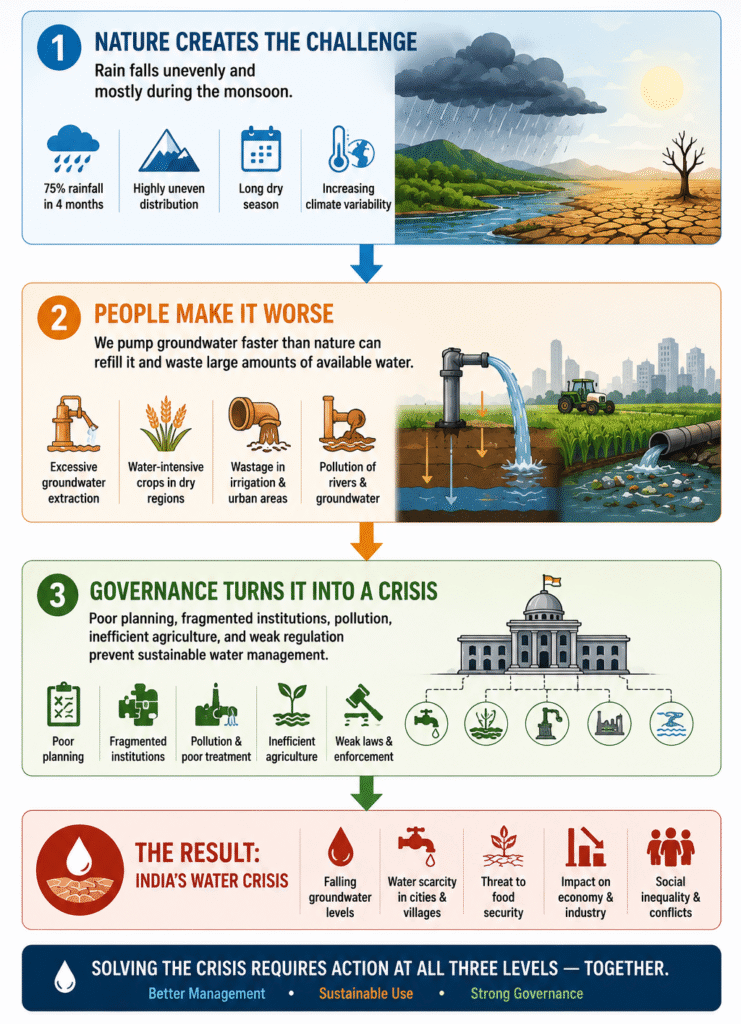
Nature creates the challenge. People make it worse. Poor governance turns that challenge into a crisis.
Major Challenges facing India's Water Sector.
Apart from these three layers, India faces several interconnected challenges:
Climate Change: Climate change is making rainfall more unpredictable. Longer dry spells, erratic monsoons, flash floods, and rising temperatures are increasing pressure on India’s already stressed water resources.
Rapid Urbanisation: Cities are expanding rapidly, increasing the demand for drinking water while reducing lakes, wetlands, and open spaces that naturally recharge groundwater.
Water Pollution: Large volumes of untreated sewage and industrial waste continue to pollute rivers, lakes, and groundwater, reducing the amount of usable freshwater.
Inefficient Agriculture: Agriculture consumes nearly 80% of India’s freshwater, yet traditional flood irrigation wastes enormous quantities of water. More efficient methods like drip and sprinkler irrigation remain underutilised.
Interstate River Disputes: Conflicts over rivers such as the Cauvery, Krishna, Ravi-Beas, and Mahadayi demonstrate how increasing water stress can also create political and federal challenges.
The Big Picture
Government Initiatives.
India has launched several programmes to improve water security, including:
- Jal Jeevan Mission – Providing tap water to every rural household.
- Atal Bhujal Yojana – Sustainable groundwater management.
- Jal Shakti Abhiyan – Rainwater harvesting and water conservation.
- Namami Gange Programme – Cleaning and rejuvenating the River Ganga.
- Pradhan Mantri Krishi Sinchayee Yojana (PMKSY) – Improving irrigation efficiency through the motto “Per Drop More Crop.”
These initiatives aim to improve both water availability and water management.
Can India's Water Crisis be solved?
Yes—but only if all three layers are addressed together.
We cannot control where or when it rains. But we can:
- Store more rainwater through better water harvesting.
- Recharge groundwater naturally.
- Shift towards less water-intensive crops.
- Improve irrigation efficiency.
- Recycle and reuse wastewater.
- Reduce leakages in urban water supply.
- Strengthen coordination between different water management agencies.
In other words, the solution is not simply to find more water, but to manage the water we already have more wisely.
The Great Nicobar Project is one of India’s most ambitious infrastructure and maritime development projects. Located at the southernmost edge of India, the project aims to transform Great Nicobar Island into a major strategic, military, shipping, and economic hub in the Indo-Pacific region.
At the center of the project is a massive International Container Transshipment Terminal (ICTT) at Galathea Bay, along with a new airport, smart city, power plant, and tourism infrastructure.
However, the project has also triggered intense debate because it lies inside one of India’s richest biodiversity zones and overlaps with tribal reserve areas.
What is the Great Nicobar Project?
The Great Nicobar Island Project is a ₹72,000–92,000 crore mega-development plan aimed at turning India’s southernmost island into a global maritime hub.
The project includes:
- International Container Transshipment Terminal (ICTT)
- Greenfield International Airport
- Smart City
- 450 MVA power plant
- Tourism infrastructure
- Military-ready dual-use facilities
The project is being led by ANIIDCO (Andaman and Nicobar Islands Integrated Development Corporation).
Why is the Great Nicobar so important?
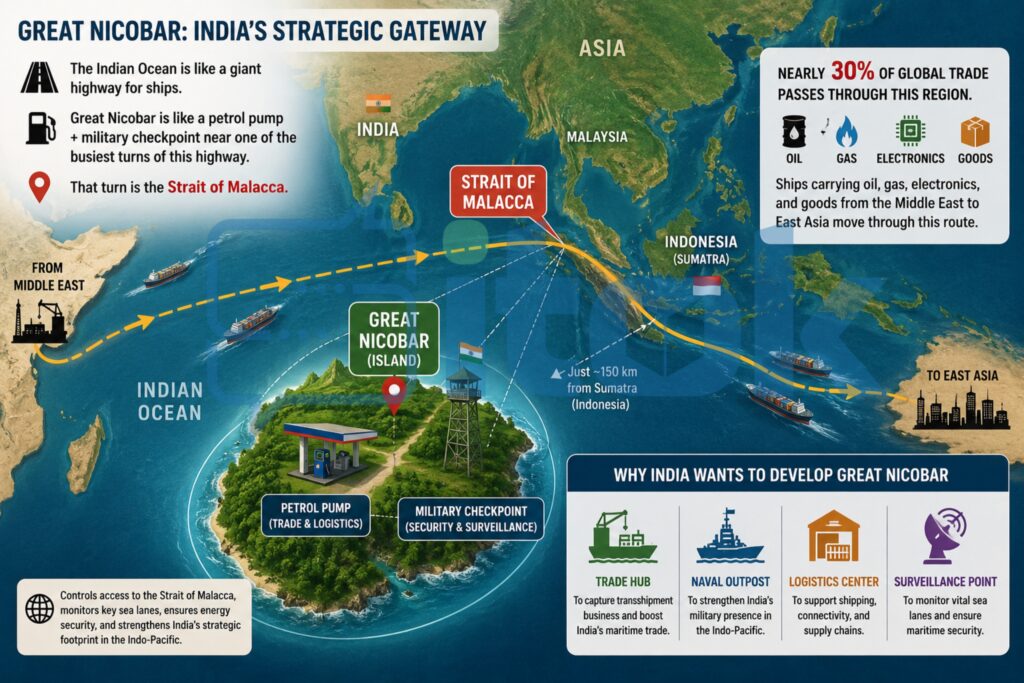
Imagine the Indian Ocean as a giant highway for ships.
Now imagine Great Nicobar as a petrol pump + military checkpoint sitting near one of the busiest turns of that highway.
That “turn” is the Strait of Malacca.
Nearly 30% of global trade passes through this region. Ships carrying oil, gas, electronics, and goods from the Middle East to East Asia move through this route.
Because Great Nicobar sits very close to this chokepoint, India wants to use it as:
- A trade hub
- A naval outpost
- A logistics center
- A surveillance point
Why the Location Matters?
Think of world trade like traffic moving through narrow roads. The Strait of Malacca is one of the world’s busiest “traffic signals.” Whoever can monitor this area gains huge strategic advantage. That is why countries like India, China, USA- all focus heavily on the Indo-Pacific region. Great Nicobar gives India a front-row seat.
Core Components of the Great Nicobar Project.
International Container Transshipment Terminal
This is the heart of the project.
Today, many Indian cargo ships use foreign ports like Singapore and Colombo for cargo transfer. India loses huge revenue because of this. The ICTT aims to bring that business back to India.
Greenfield International Airport
The airport will handle:
• civilian flights
• cargo movement
• military aircraft
This is why it is called a dual-use airport.
Smart City
A modern township is planned for around 6.5 lakh people by 2050.
It will include housing, hospitals, schools, digital infrastructure.
Power Plant
A 450 MVA hybrid power plant (gas + solar) is proposed to support the new city and industries.
Tourism Infrastructure
Government plans to develop:
- Eco-tourism
- Resorts
- Cruise tourism
to make the island a high-end tourism destination.
Strategic Importance of the Nicobar Project.
Countering China in Indo Pacific
China’s growing naval presence in the Indian Ocean is often referred to as the “String of Pearls” strategy.
Great Nicobar helps India maintain strategic balance.
Maritime Surveillance
India can monitor ship movement near the Strait of Malacca.
This improves naval preparedness, anti-piracy operations, maritime domain awareness.
Economic Sovereignty
India currently depends on foreign ports for transshipment.
This project aims to make India a major shipping hub.
Blue Economy
The project supports India’s Blue Economy vision:
Using ocean resources for trade, energy, tourism, economic growth.
Environmental Concerns
The project requires diversion of ~130 sq km forest land and cutting nearly 10 lakh trees. The island is part of a Global Biodiversity Hotspot.
Why Environmentalists are worried?
The island contains tropical evergreen forests, coral reefs, endemic species and turtle nesting grounds. Many species exist nowhere else on Earth.
Giant Leatherback Turtle Issue
Galathea Bay is one of the world’s important nesting grounds for the Giant Leatherback Sea Turtle.
Environmentalists fear dredging, ship movement, noise and artificial lighting could destroy their breeding cycle.
Threat to Tribal Communities
The island is home to:
1. Shompen Tribe
• Hunter-gatherer community
• Classified as PVTG (Particularly Vulnerable Tribal Group)
2. Nicobarese Tribe
• Scheduled Tribe community
• Mostly coastal settlements
Critics argue that bringing lakhs of outsiders could disrupt tribal lifestyle, introduce diseases, destroy cultural identity.
Arguments in Favour
- India cannot ignore strategic geography
- Indo-Pacific competition is increasing
- Economic benefits are massive
- Infrastructure gap must be addressed
- Security concerns require forward bases
Arguments Against
- Irreversible ecological damage
- Tribal displacement
- Biodiversity loss
- Coral destruction
- Climate vulnerability
Way Forward
Experts suggest:
- Multi-season environmental studies
- Strict eco-sensitive buffer zones
- Green port technologies
- Tribal participation in decision-making
- Climate-resilient infrastructure
The Nipah virus outbreak in 2026 has once again raised serious public health concerns in India, particularly in West Bengal. Classified as a high-fatality zoonotic disease, the Nipah virus (NiV) has historically caused localized but deadly outbreaks in South and Southeast Asia. With recent confirmed clusters near Kolkata, the virus has returned to national and international focus.
What is Nipah virus?
The Nipah virus (NiV) is a zoonotic RNA virus belonging to the Henipavirus genus. It primarily spreads from animals to humans, but human-to-human transmission is also possible.
The natural reservoir of the Nipah virus is fruit bats of the Pteropus genus (flying foxes). These bats carry the virus without becoming ill and shed it through saliva, urine, and feces.
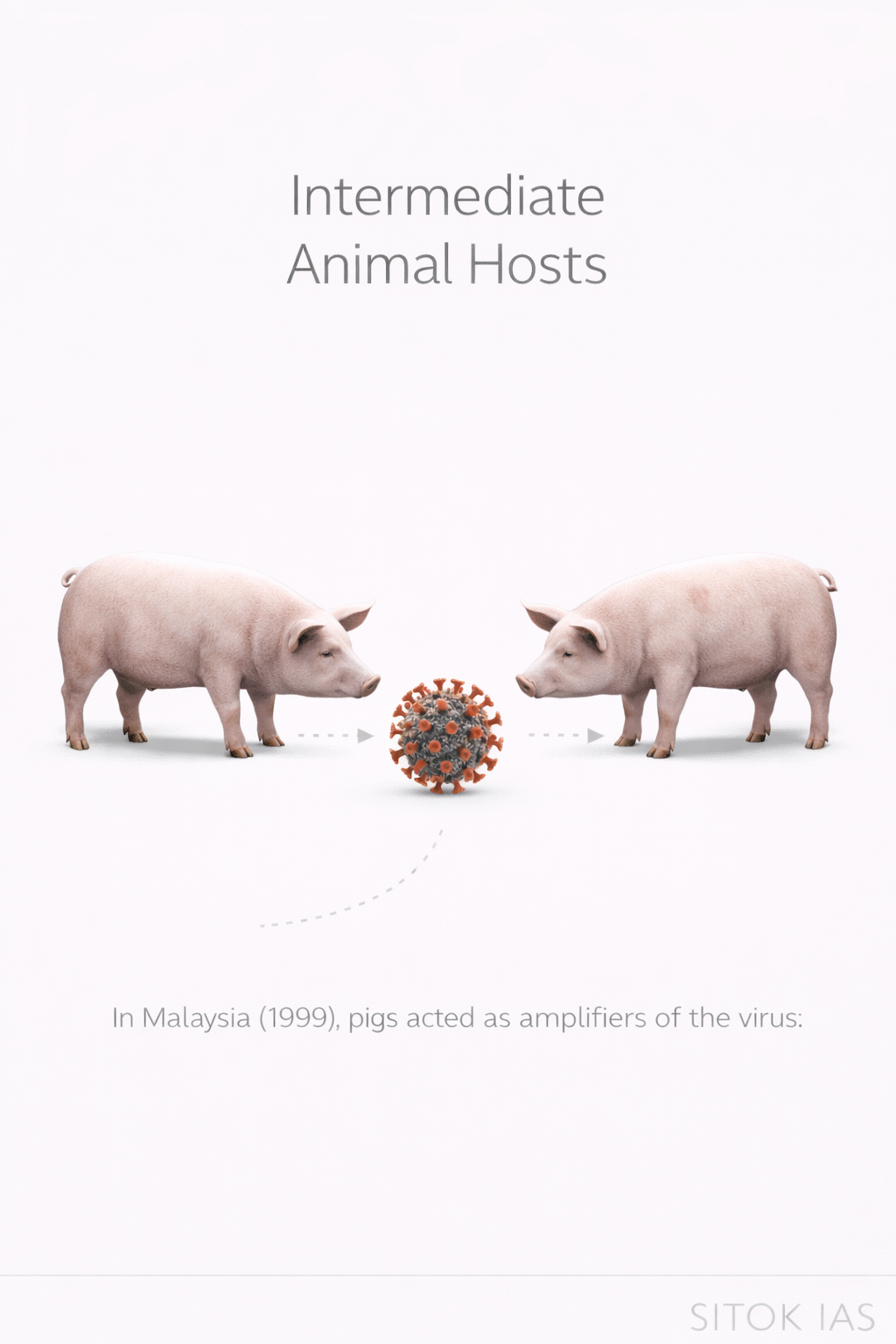
The virus was first identified during the 1998–1999 Malaysia outbreak, where pigs acted as intermediate hosts before infecting farmers.
Nipah Virus Outbreak 2026: Why is it in the News?
The 2026 outbreak has emerged in West Bengal, particularly near Kolkata.
Key developments:
- Confirmed cluster of infections in Barasat
- Healthcare workers infected (nosocomial spread)
- Over 190 high-risk contacts traced
- International thermal screening initiated by neighboring countries
- Renewed emphasis on the “One Health” approach
This marks the first significant cluster in West Bengal in nearly two decades.
How does Nipah virus spread?


1. Bat to Human
Most common route in India and Bangladesh:
- Consumption of raw date palm sap contaminated by bats
- Eating partially eaten fruits
- Contact with bat secretions
2. Intermediate Animal Hosts.
In Malaysia (1999), pigs acted as amplifiers of the virus.
3. Human to Human Transmission
- Respiratory droplets
- Direct contact with bodily fluids
- Hospital transmission (Nosocomial infections)
Unlike COVID-19, Nipah virus does not spread easily through casual airborne exposure. It requires close contact.
Nipah Virus Symptoms and Clinical Progression
The incubation period typically ranges from 4–14 days, but can extend up to 45 days in rare cases. The fatality rate ranges between 40% to 75%, making it far deadlier than COVID-19.Even survivors may experience long-term neurological complications.
Early symptoms:
- High fever
- Headache
- Muscle pain
- Sore throat
Severe symptoms:
- Acute Respiratory Distress Syndrome (ARDS)
- Brain swelling (Encephalitis)
- Seizures
- Coma
Nipah Virus Fatality Rate
Historically:
- Malaysia (1999): ~40%
- India & Bangladesh outbreaks: 60–75%
- The 2001 Siliguri outbreak had a fatality rate of ~68%
This high case fatality rate is why the WHO lists Nipah as a Blueprint Priority Disease.
A Blueprint Priority Disease is a term used by the World Health Organization (WHO) for diseases that are very dangerous, can spread quickly, and do not yet have proper medicines or vaccines. These diseases have the potential to cause serious outbreaks or even global health emergencies. Because of this risk, WHO places them on a priority list so that scientists and governments focus on fast-tracking research, developing vaccines, improving treatments, and strengthening preparedness systems. Nipah virus is classified as a Blueprint Priority Disease because it has a high fatality rate, can spread between humans, and currently has no widely available vaccine.
Is There a Nipah Virus Vaccine?
Currently, there is no licensed Nipah virus vaccine for public use. However:
- PHV02 vaccine candidate – Phase II trials in Bangladesh
- ChAdOx1 NipahB (Oxford) – Under evaluation
Experimental monoclonal antibody treatments are being used under compassionate use protocols.
Prevention and Control Measures
Governments focus on:
- Boiling date palm sap
- Avoiding windfall fruits
- PPE use in hospitals
- Isolation wards with negative pressure
- Livestock monitoring
The 2026 outbreak reinforces the importance of One Health surveillance — integrating wildlife, livestock, and human health systems.
One Health surveillance is a system of monitoring diseases by looking at human health, animal health, and environmental health together, instead of separately. The idea is simple: many dangerous diseases (like Nipah, Ebola, COVID-19) start in animals and then spill over to humans. So if we only track human patients, we are already late.
Under One Health surveillance:
- Doctors monitor unusual symptoms in people
- Veterinarians track diseases in livestock and wildlife
- Environmental experts observe changes in ecosystems (deforestation, climate shifts, bat migration, etc.)
All three sets of data are combined to detect early warning signs of outbreaks.
For example, in the case of Nipah virus:
If fruit bats are found carrying the virus → livestock is monitored → nearby human cases are quickly traced and isolated.
So, One Health surveillance is about early detection through coordination between health, veterinary, and environmental systems, to prevent small outbreaks from becoming major public health crises.
Monkeypox (now officially referred to as Mpox) is a viral zoonotic disease caused by the Monkeypox virus, a member of the Orthopoxvirus genus. First identified in the Democratic Republic of Congo in 1970, the virus has resurfaced globally, raising renewed public health concerns. In India, the first confirmed case was reported in Kerala in July 2022, and by August 2024, more than 30 cases had been documented.
For UPSC aspirants, Mpox intersects with:
- Public health surveillance
- Zoonotic disease management
- Biotechnology & vaccines
- National health infrastructure
- Post-COVID preparedness
What is Monkey Pox (MPox)?
Monkeypox is a viral infection transmitted from animals to humans (zoonotic disease) and between humans through close contact. It is genetically related to smallpox but generally less severe.
Monkey Pox Symptoms
- Fever
- Headache
- Muscle aches
- Back pain
- Swollen lymph nodes (key differentiator from smallpox)
- Rash starting on face → spreading to body
The presence of swollen lymph nodes is clinically significant because it helps differentiate Mpox from smallpox.
How does Monkey Pox spread?
Transmission occurs through:
- Close physical contact with infected individuals
- Contact with infected animals
- Contaminated materials (clothing, bedding)
Unlike COVID-19, it is not primarily airborne. This lower transmissibility reduces pandemic potential but does not eliminate outbreak risks.
Monkey Pox vs COVID 19
COVID-19
SARS-CoV-2
2-14 days
~1-2% globally
Widely available.
MONKEY POX
Orthoproxvirus
5-21 days
1-10%(varies by strain)
Limited (smallpox vaccine provides protection)
FACTORS
Causative Agent
Incubation
Mortality
Vaccine
MONKEY POX
Orthoproxvirus
5-21 days
1-10%(varies by strain)
Limited (smallpox vaccine provides protection)
COVID-19
SARS-CoV-2
2-14 days
~1-2% globally
Widely available.
Monkey Pox Mortality Rate
Historically, mortality has ranged between 1–10%, depending on strain.
However:
- The 2022–24 global outbreak showed lower fatality rates.
- Immunocompromised individuals remain high risk.
Compared to COVID-19, Mpox is less contagious but potentially more severe in untreated cases.
Current Spread in India
Reported regions include:
- Kerala
- Delhi
- Other scattered regions
India has so far avoided widespread transmission, largely due to early surveillance and contact tracing.
Key Challenges in tackling Monkey Pox.
Limited Public Awareness
Health Infrastructure Strain (post-COVID burden)
Stigma & Misinformation
Limited Vaccine Accessibility
The vaccine challenge is critical — unlike COVID-19, Mpox-specific vaccines are not widely available
National Response Strategy
- Enhanced surveillance at borders
- Public awareness campaigns
- Stockpiling vaccines & antivirals
This aligns with India’s One Health surveillance framework ->.
The Artemis II mission marks humanity’s return to deep space after more than 50 years since the Apollo era. Launched by NASA in April 2026, this mission is the first crewed mission of the Artemis program, designed to take astronauts beyond Low Earth Orbit (LEO) and around the Moon.
Unlike the Apollo missions, Artemis II is not about landing. It is a high-risk, high-precision test mission that will validate whether humans can survive and operate in deep space for future missions — including Artemis III and eventually Mars exploration.
For UPSC aspirants, Artemis II connects with space technology, international cooperation, geopolitics, and future resource competition in space.
Why Artemis II is Important (UPSC Angle)?
Artemis II is relevant across multiple GS papers:
- Science & Technology: Space missions, deep space exploration
- International Relations: Artemis Accords, US-led vs China-led space race
- Economy: Emerging lunar economy and resource extraction
- Security: Strategic importance of cislunar space
- Environment & Ethics: Space governance and sustainability
What is Artemis II?
Artemis II is a crewed lunar flyby mission, where astronauts will travel around the Moon and return to Earth without landing.
Key features:
- Duration: ~10 days
- Crew: 4 astronauts
- Spacecraft: Orion
- Launch Vehicle: Space Launch System (SLS)
- Objective: Test systems required for human survival in deep space
This mission acts as a bridge between Artemis I (uncrewed) and Artemis III (planned lunar landing).
Current Spread in India
1. Crewed Deep Space Validation
First human mission beyond Low Earth Orbit since Apollo.
2. No-Landing Test Mission
Focus is on systems testing, not surface exploration.
3. Hybrid Free-Return Trajectory
Spacecraft will follow a path where Earth’s gravity brings it back automatically, even if propulsion fails.
4. Testing Life Support System (ECLSS)
Oxygen supply
CO₂ removal
Temperature control
This is critical for long-duration missions.
5. Deep Space Communication
Testing NASA’s Deep Space Network (DSN) for communication over ~400,000 km.
6. Radiation Exposure Monitoring
Astronauts will move beyond Earth’s magnetic shield, facing:
Solar radiation
Cosmic rays
7. High-Speed Re-entry
Capsule will re-enter Earth’s atmosphere at Mach 32, testing extreme heat resistance.
Artemis II Trajectory
Artemis II will follow a lunar flyby trajectory, looping around the Moon’s far side.
Key elements:
- Trans-Lunar Injection (TLI): Spacecraft accelerates to ~39,000 km/h
- Travels beyond Moon (~10,000 km past far side)
- Uses gravity of Earth + Moon to return
This is called a free-return trajectory, ensuring safety in case of system failure.
Technology Behind.
Space Launch System (SLS)
Most powerful rocket ever built
~8.8 million pounds thrust
More powerful than Saturn V
Orion Spacecraft
Designed for deep space missions
Supports 4 astronauts
Advanced safety redundancy
European Service Module (ESA)
Provides power, propulsion, oxygen, water
Uses solar panels
Optical Communication System
Laser-based communication
Enables high-speed data transfer (even HD video)
Heat Shield (Avcoat)
Withstands ~2800°C during re-entry
Uses ablative technology
Why Moon is becoming important again?
The Moon is now seen as a gateway to deep space, not just a destination.
Launchpad for Mars
Lower gravity makes it easier to launch missions deeper into space.
Water Ice at South Pole
Can be converted into:
Oxygen
Hydrogen fuel
In Situ Resource
Using lunar soil for:
Construction
Fuel production
Lunar Economy
Future industries may include:
Mining
Energy
Space logistics
India's Position
India signed the Artemis Accords (2023).
Implications:
- Participation in global space governance
- Collaboration with NASA
- Opportunities for Indian private sector
- Balance between cooperation and strategic autonomy
India continues parallel efforts through:
- Chandrayaan missions
- Gaganyaan program
Challenges of DEEP SPACE
1. Radiation Exposure
Beyond Earth’s magnetosphere, radiation risk is very high.
2. Communication Delay
Astronauts must operate autonomously.
3. Life Support Reliability
No quick rescue possible.
4. Psychological Stress
Isolation + confined space.
5. Space Debris and Micrometeoroids
Even tiny particles can cause major damage.
Way Forward.
Future space missions will depend on:
- Closed-loop life support systems
- Nuclear propulsion technologies
- International space governance frameworks
- Sustainable lunar infrastructure
A global “rules of the road” system will be essential to avoid conflict in space.
India’s nuclear programme is one of the most unique in the world. Unlike most countries, India designed a long-term nuclear strategy based on its resource reality — limited uranium but abundant thorium.
This led to the creation of the three-stage nuclear programme, conceptualised by Homi J. Bhabha, which remains the backbone of India’s nuclear policy even today.
At its core, India’s nuclear programme is not just about electricity generation. It is about:
- Energy security
- Strategic autonomy
- Long-term sustainability
- Climate commitments
What is Nuclear Energy?
Nuclear energy is the energy stored inside the nucleus of an atom. When this nucleus is broken (fission), a large amount of energy is released.
Simple idea:
- Atom = tightly packed energy
- Break nucleus → energy released
This energy is used to produce heat, which ultimately generates electricity.
Feature
Basic idea
Fuel Used.
Process
Energy Output.
By-Products.
Conditions.
Where it happens?
Control.
Current Use.
Example.
Fission
Splitting Heavy Atom.
Uranium/Plutonium
Large nucleus splits into smaller.
High
Radioactive waste.
Can occur at lower temp.
Nuclear reactors, bombs.
Can be controlled.
Electricity.
Breaking big rock into pieces.
Fussion
Joining light atoms.
Hydrogen isotopes.
Small nuclei combine.
More than fission.
Minimal waste.
Extreme high temp and pressure.
Sun and stas.
Difficult to control.
Not yet commercially viable.
2 water droplets merging.
Feature
Basic idea
Fuel Used.
Process
Energy Output.
By-Products.
Conditions.
Where it happens?
Control.
Current Use.
Example.
Fission
Splitting Heavy Atom.
Uranium/Plutonium.
Large nucleus splits into smaller.
High
Radioactive waste.
Can occur at lower temp.
Nuclear reactors, bombs.
Can be controlled.
Electricity.
Breaking big rock into pieces.
Fussion
Joining light atoms.
Hydrogen isotopes.
Small nuclei combine.
Very High (more than fission).
Minimal waste.
Extreme high temp and pressure.
Sun and stas.
Difficult to control.
Not yet commercially viable.
2 water droplets merging.
How Nuclear Energy is generated?
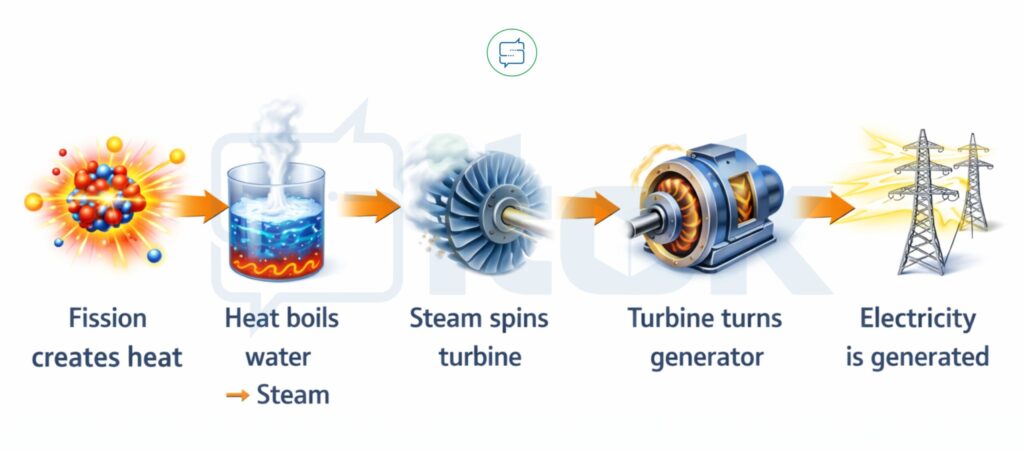
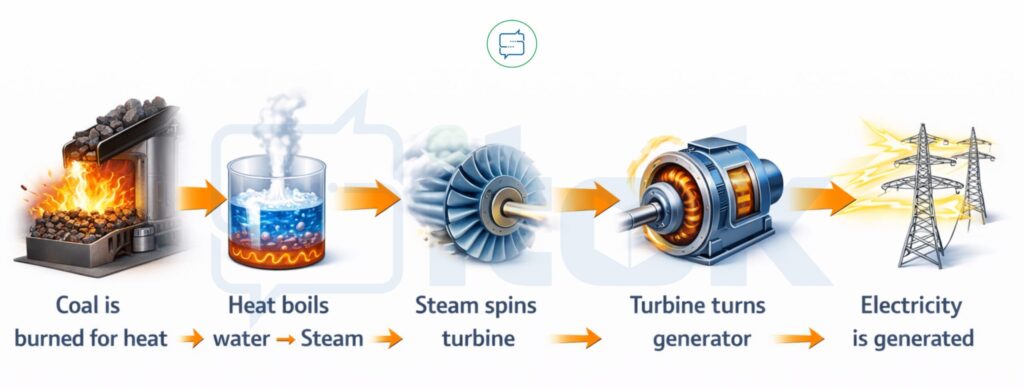
The process is simple. It is just like producing electricity from other sources like coal:
- Nuclear fission produces heat
- Heat converts water into steam
- Steam rotates turbine
- Turbine runs generator
- Electricity is produced
Important insight: Nuclear plants are not directly producing electricity — they are heat-producing systems, just like thermal power plants.
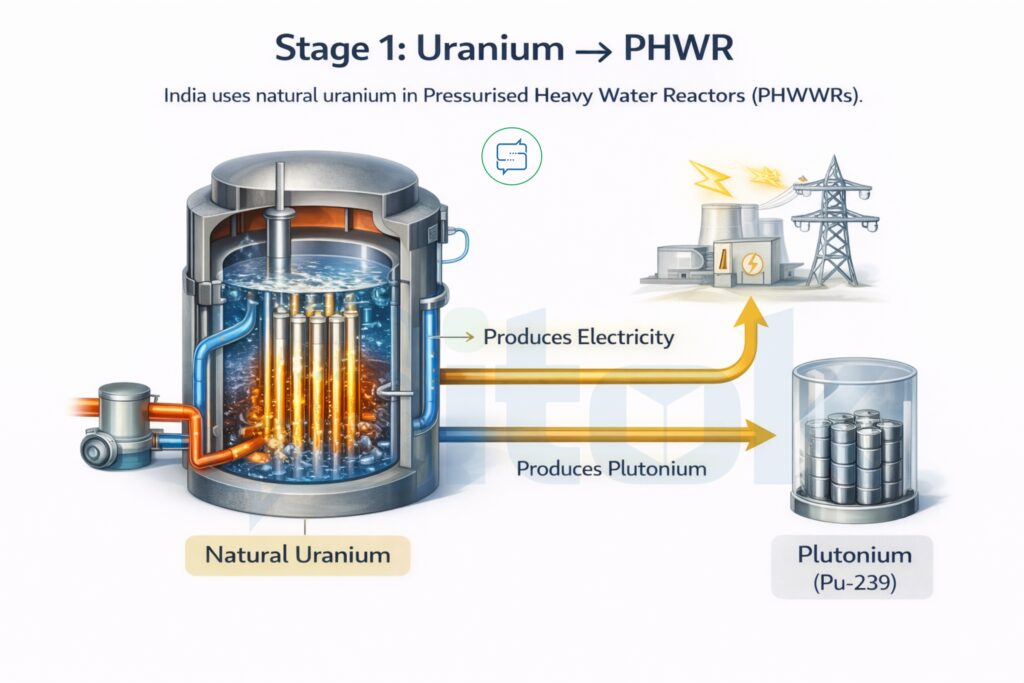
Stage 1: PHWR Stage (Present)
Fuel: Natural uranium
Output: Electricity | Plutonium (Pu-239)
Purpose: Generate power + produce plutonium
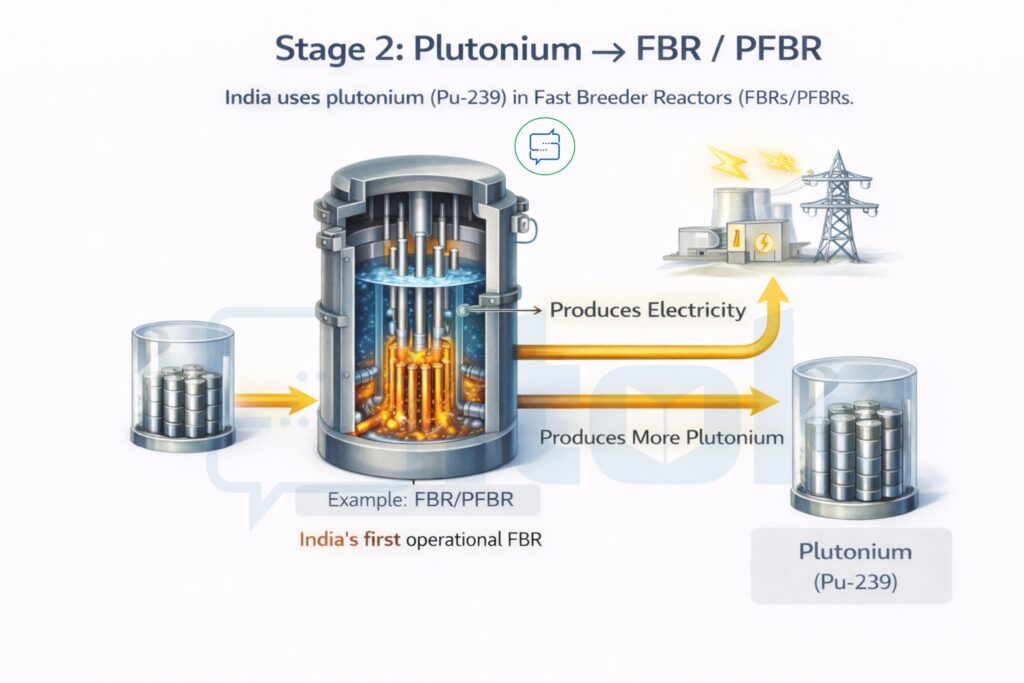
Stage 2: FBR Stage (Transition)
Fuel: Plutonium
Output: Electricity | More fissile material | Neutrons
Purpose: Multiply fuel and create conditions for thorium use
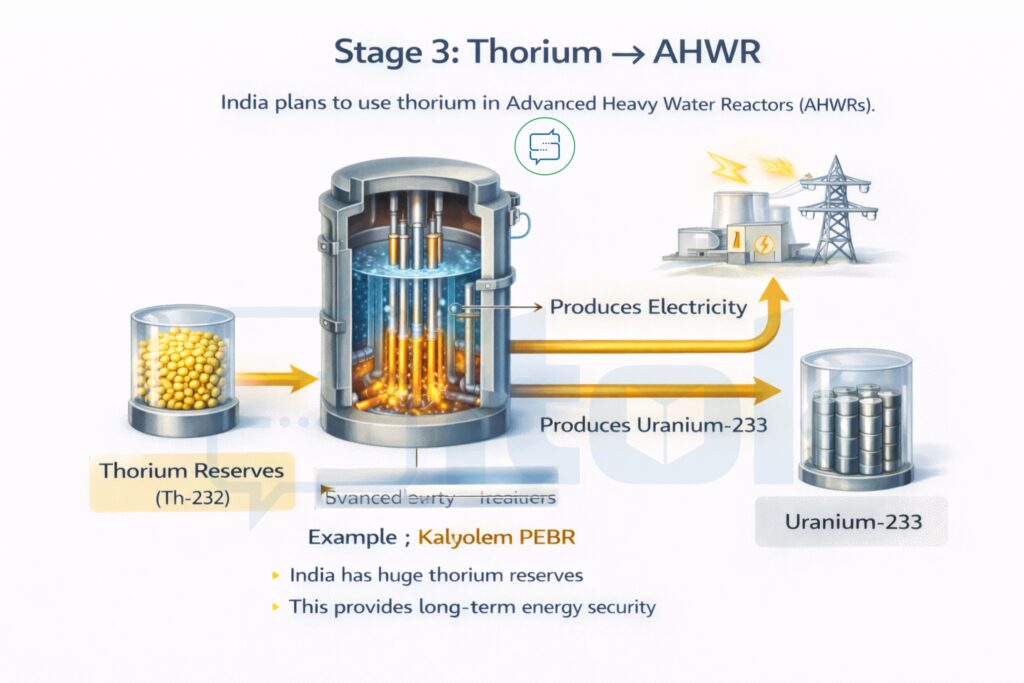
Stage 3: Thorium Stage (Future)
Fuel: U-233 (from thorium)
Process: Thorium absorbs neutrons | Converts into U-233.
Purpose: Achieve long-term energy independence
PFBR (Prototype Fast Breeder Reactor): Latest Development
India’s PFBR at Kalpakkam achieving criticality is a major milestone. Why it matters:
- Makes Stage 2 operational
- Produces more fuel than it consumes
- Enables transition to thorium
- Reduces uranium import dependence
This is the bridge between present and future.
What is Thorium and why India focuses on it?
Thorium (Th-232):
- Found in India’s coastal sands
- Cannot be used directly as fuel
Thorium → absorbs neutron → becomes U-233 → usable fuel
Why Important:
- India has large thorium reserves
- Ensures long-term energy security
- Lower waste and safer profile
India's Nuclear Journey (Historical Timeline)
Phase 1: Scientific Foundation
- Homi Bhabha leadership
- Atomic Energy Commission (1948)
- DAE (1954)
Phase 2: Strategic Shift
- 1974: Pokhran-I (Smiling Buddha)
- 1998: Pokhran-II
India becomes nuclear weapons state.
Phase 3: Global Integration
2008: India-US Civil Nuclear Deal | NSG waiver. Benefits:
- Uranium imports
- Technology access
- Expansion of civilian programme
Major Nuclear Disasters
The Chernobyl Disaster took place in 1986 in the Soviet Union (present-day Ukraine) and is considered the worst nuclear accident in history. The reactor used at Chernobyl was an RBMK type, which had a major design flaw. Unlike safer reactors, it used graphite as a moderator and did not have a strong containment structure to trap radiation in case of an accident. The disaster began during a safety test in which operators wanted to check whether the reactor could still be cooled during a power outage. To conduct this test, they reduced the reactor’s power and, critically, switched off several safety systems.
At low power levels, the RBMK reactor became highly unstable. Instead of slowing down, the nuclear reaction started behaving unpredictably due to increased steam formation, which actually accelerated the reaction rather than controlling it. When the operators realised things were going wrong, they pressed the emergency shutdown button. However, due to a flaw in the control rods, this action initially increased the reaction instead of stopping it. Within seconds, there was a massive power surge, leading to a steam explosion that blew off the reactor lid. The exposed core released radioactive material into the atmosphere, and the graphite caught fire, further spreading radiation.
The situation became extremely dangerous because there was no proper containment building, the reactor design was flawed, and human errors worsened the situation. Initially, the Soviet government tried to suppress information and delayed evacuation. Eventually, nearby areas like Pripyat were evacuated, and a massive concrete structure, known as a sarcophagus, was built to contain the radiation. The disaster spread radioactive material across large parts of Europe. The key lesson from Chernobyl is that a combination of poor reactor design and human error can lead to catastrophic consequences.
The Fukushima Disaster occurred in Japan in 2011 and represents a very different kind of nuclear accident. The reactors at Fukushima were Boiling Water Reactors (BWRs), which are modern and generally considered safe. The sequence of events began with a massive earthquake, which caused the reactors to automatically shut down as designed. This part of the system worked perfectly. However, the real problem began shortly after when a powerful tsunami struck the plant.
The tsunami flooded the facility and disabled the backup diesel generators that were supposed to power the cooling systems. Even though the reactor had shut down, the fuel inside remained extremely hot and required continuous cooling. Without electricity, the cooling systems failed completely. As a result, the temperature inside the reactor began to rise. Water turned into steam, and hydrogen gas started to accumulate inside the reactor buildings.
Eventually, the buildup of hydrogen led to explosions in multiple reactor units. Although these were not nuclear explosions like in Chernobyl, they damaged the structures and led to the release of radioactive material into the environment. The situation became dangerous due to the loss of power, failure of cooling systems, and the scale of the natural disaster, which exceeded the plant’s design limits. Unlike Chernobyl, the Japanese government responded quickly by evacuating nearby populations and setting up exclusion zones. However, the cleanup process has been extremely long and continues even today.
The key lesson from Fukushima is that even a well-designed and safe reactor can become dangerous if critical systems like cooling fail, especially during extreme natural disasters. It highlighted the importance of backup systems, disaster preparedness, and designing plants for worst-case scenarios.
India's Strategy
India is moving from:
“Limited nuclear use” to “Strategic large-scale expansion”
Driven by:
- Energy demand
- Climate commitments
- Resource constraints
India’s nuclear programme is not just about reactors — it is a multi-decade strategy to transform limited resources into long-term energy security. With the success of PFBR and future thorium-based reactors, India is positioning itself as one of the few countries capable of building a sustainable nuclear future.
One Nation One Election
Electoral College | Election Process | Federal Logic | India Comparison
One Nation, One Election (ONOE) refers to conducting simultaneous elections for Lok Sabha and State Legislative Assemblies, aiming to reduce the frequency of elections and create a more stable governance cycle.
This idea is not new—India followed this system in the initial decades (1952–1967), but the cycle broke due to premature dissolutions of Assemblies and Lok Sabha, leading to the current staggered election model.
At its core, ONOE is a debate between efficiency vs federalism.
Why ONOE is Proposed?
The strongest argument in favor is governance efficiency:
Frequent elections trigger the Model Code of Conduct (MCC), slowing policy decisions
Huge financial and administrative costs are incurred repeatedly
Continuous elections create political populism and short-termism.
Simultaneous elections aim to create a 5-year stable governance window, improving long-term planning and reducing electoral fatigue.
The Core Concerns.
ONOE raises serious structural challenges:
1. Federal Structure Concerns
India’s Constitution allows states autonomy over their electoral timelines. Synchronizing elections may centralize power and weaken federal balance.
2. Accountability Deficit
Staggered elections act as periodic checks on governments. ONOE may reduce this continuous democratic feedback.
3. Dilution of Regional Issues
A single nationwide election may shift focus to national narratives, sidelining state-specific concerns.
The Real Challenge-Implementation
The biggest hurdle is not political will—but constitutional engineering.
To implement ONOE, multiple constitutional provisions must be amended:
Articles 83, 85 → Lok Sabha tenure and dissolution
Articles 172, 174 → State Assembly tenure and dissolution
Article 356 → President’s Rule adjustments
Additionally:
Handling mid-term dissolutions is complex
Massive logistical coordination (EVMs, security, manpower) is required
Amendments to the Representation of the People Act, 1951 are necessary
Way Forward
Phased implementation (as suggested by NITI Aayog)
Mechanism for constructive vote of no-confidence or fixed terms
Safeguards for regional representation
Broad political consensus.
U.S. Elections | Compared to India
Electoral College | Election Process | Federal Logic | India Comparison
The U.S. electoral system fundamentally differs from India’s due to its Presidential form of government, where the executive is directly elected (indirectly via electors) and operates independently of the legislature. In contrast, India follows a Parliamentary system, where the executive emerges from the legislature.
At the core of the U.S. system is the Electoral College, a unique indirect mechanism where citizens vote not for the President directly, but for a “slate of electors” pledged to a candidate. Each state is assigned electors based on its total representation in Congress (House + Senate), and a candidate needs 270 out of 538 electoral votes to win. Most states follow a winner-takes-all system, except Maine and Nebraska, which use a district-based allocation.
Election Process
The election process is multi-layered and stretched over months:
Primaries & Caucuses decide party nominees
National Conventions formally declare candidates
General Election Campaign focuses heavily on swing states
General Election determines electors
Electoral College voting formally elects the President.
This layered structure reflects a balance between popular will and federal structure, ensuring smaller states retain influence.
In comparison, India’s system is simpler and more direct:
Lok Sabha elections follow First-Past-The-Post (FPTP)
Prime Minister is chosen from the majority in Parliament
No intermediate layer like the Electoral College
The U.S. legislative elections also differ significantly:
House of Representatives: Direct elections every 2 years, population-based districts
Senate: Equal representation (2 per state), staggered 6-year terms
This creates a dual principle of representation:
Population-based (House)
State equality (Senate)
The U.S. system prioritizes federal balance and checks on direct democracy, while India emphasizes simplicity, direct representation, and parliamentary accountability. The U.S. electoral system is complex, layered, and federal in spirit, whereas India’s system is direct, efficient, and parliamentary in nature—both reflecting their historical and constitutional priorities.
Delimitation in India refers to the process of redrawing the boundaries of electoral constituencies to ensure equal representation based on population changes. In a democracy like India, this process ensures that each elected representative (MP/MLA) represents roughly the same number of citizens.
The issue has gained renewed importance ahead of the expected post-2026 delimitation exercise, which could significantly reshape India’s political landscape, federal balance, and parliamentary representation.
What is Delimitation?
Delimitation is the process of fixing or redrawing the boundaries of territorial constituencies in a country.
In simple terms:
It ensures “One Person, One Vote, One Value.”
If populations change over time and boundaries are not updated, some representatives may represent far more people than others—leading to unequal political power. Delimitation corrects this imbalance.
Why is Delimitation Important?
- Ensures equal representation across constituencies.
- Prevents political imbalance due to population shifts.
- Enables fair elections.
- Helps in reservation of seats for SC/ST communities.
- Strengthens democratic legitimacy.
Constitutional Provisions for Delimitation
The Constitution provides the legal framework:
- Article 82 – Parliament enacts Delimitation Act after every Census
- Article 170 – States divided into constituencies for Assemblies
- Article 327 – Parliament can make laws related to elections
- Article 329 – Courts cannot interfere in delimitation decisions
This ensures both legal backing and finality of the process.
Delimitation Commission: Role & Composition
The Delimitation Commission is an independent body appointed by the President.
COMPOSITION:
- Retired/Sitting Supreme Court Judge (Chairperson)
- Chief Election Commissioner
- State Election Commissioners
KEY POWERS:
- Orders have force of law
- Cannot be challenged in courts
- Final decisions cannot be modified by Parliament
- Can summon records like a civil court
What is the Delimitation Freeze? (84th Amendment)
India currently follows a freeze on total seats:
- Based on 1971 Census (seat allocation)
- Boundaries updated using 2001 Census
- Freeze valid until first Census after 2026
WHY THIS MATTERS
- Prevents penalizing states that controlled population
- Maintains federal balance
- Avoids frequent political restructuring.
Why is Delimitation a Big Issue in 2026?
Post-2026 delimitation could:
- Increase total Lok Sabha seats
- Shift power toward high-population states.
- Trigger North vs South political debate
- Impact federal balance
Key Challenges in Delimitation
1. NORTH SOUTH DIVIDE
Northern states may gain seats due to higher population growth, while southern states may lose relative influence.
2. “Penalty for Performance”
States with better population control fear reduced representation.
3. Federal Imbalance
Power concentration in few states may weaken cooperative federalism.
4. Minority Representation Issues
Boundary changes can affect community representation.
The 131st Constitutional Amendment Bill (2026) Debate
A major recent development in delimitation politics.
What the Bill Proposed:
- Increase Lok Sabha seats (up to 850)
- Start delimitation using 2011 Census
- Enable Women’s Reservation implementation
Why it Failed:
- Opposition to linking delimitation with reservation
- Concerns over outdated 2011 data
- Fear of political imbalance
- No written safeguards for southern states
Current Status: Delimitation will now likely happen after Census post-2026.
Way Forward
Experts suggest:
- Expanding Lok Sabha without reducing seats
- Weighted representation (HDI + population)
- Strengthening Rajya Sabha as federal safeguard
- Ensuring political consensus before implementation
The Iran Crisis 2026 marks the most serious internal challenge faced by the Islamic Republic since 1979. What began as protests over rising prices evolved into a nationwide political and economic crisis with regional and global consequences.
What Happened Recently in Iran?
In January 2026, nationwide protests spread across all 31 provinces and over 170 locations. Demonstrations initially focused on economic distress but gradually questioned the legitimacy of the regime itself.
The Iranian government responded with:
- Nationwide internet shutdown (8 January 2026)
- Deployment of IRGC and Basij forces
- Mass arrests and emergency legal measures
Simultaneously, the United States increased military signalling in the Persian Gulf and expanded secondary sanctions. This transformed a domestic crisis into an international geopolitical flashpoint.
Why is Iran in Crisis?
Economic Collapse
The Iranian Rial depreciated sharply, reaching nearly 1.5 million per US dollar.
Consequences:
- 70%+ food inflation
- 50% rise in medical costs
- Severe erosion of household savings.
This rapid economic deterioration triggered mass public dissatisfaction.
Snapback Sanctions & Nuclear
Following Israel–Iran tensions in 2025, European powers activated the “Snapback” mechanism, re-imposing UN sanctions.
This:
- Reduced Iran’s global market access
- Increased economic isolation
- Constrained oil revenue channels.
The disruption of Iran’s “shadow fleet” oil exports in January 2026 further reduced state revenue
Political Legitimacy Crisis
Despite the election of President Masoud Pezeshkian in 2024, structural constraints limited reform.
Public frustration shifted from reform demands to systemic change.
The weakening of the traditional Bazaar–Clergy alliance further eroded regime stability
Social and Environmental Stress
- Legacy of Mahsa Amini protests
- Ethnic marginalisation in Kurdish & Sistan regions.
- Severe air pollution from Mazut usage
- Water scarcity & land subsidence.
These compounded economic grievances into structural instability.
Global Implication of Iran Crisis
1. Energy Market Volatility
Iran’s proximity to the Strait of Hormuz — through which nearly 20% of global oil trade passes — triggered oil price volatility.
Any escalation could:
- Increase global inflation
- Disrupt supply chains
- Impact developing economies severely
2. Expansion of Secondary Sanctions
On 12 January 2026, the U.S. announced a 25% tariff on countries continuing trade with Iran.
Impact of Iran Crisis on India
1. India’s Exit from Chabahar Port.
On 16 January 2026, India stepped back from operating the Chabahar Port.
Why?
- U.S. secondary sanction risk
- $132B India–US trade vs $1.6B India–Iran trade.
2. Energy Security Risks
Although India imports limited oil from Iran currently, around 45% of India’s oil imports come from West Asia.
Any Strait of Hormuz disruption would:
- Increase oil prices
- Raise inflation
- Strain fiscal stability
3. Strategic Autonomy Challenge
India must balance relations between:
- Iran
- Israel
- Gulf States
- United States
The crisis tests India’s West Asia diplomatic flexibility.
The Way Forward
Iran’s future depends on:
- Reform vs repression
- Sanctions relief negotiations
- Internal power shifts between IRGC and other institutions.
For India, diversification of energy sources and cautious diplomatic engagement remain essential.
The Venezuela Crisis 2026 marks one of the most controversial geopolitical developments of the decade. In a dramatic move, the United States carried out a direct military operation inside Venezuelan territory and took into custody the sitting Venezuelan President, Nicolás Maduro. This unprecedented action has triggered global debate over:
- Sovereignty and territorial integrity
- UN Charter violations
- Oil geopolitics
- The future of the rules-based international order
- Strategic autonomy of countries like India
For UPSC aspirants, this crisis connects International Relations, energy security, international law, and global power politics.
Economic Collapse of Venezuela
A critical enabling factor was Venezuela’s internal economic breakdown.
Oil production collapsed due to mismanagement.
Hyperinflation destroyed the currency.
Over 7 million Venezuelans migrated.
Military morale weakened.
This internal hollowing made external intervention easier.
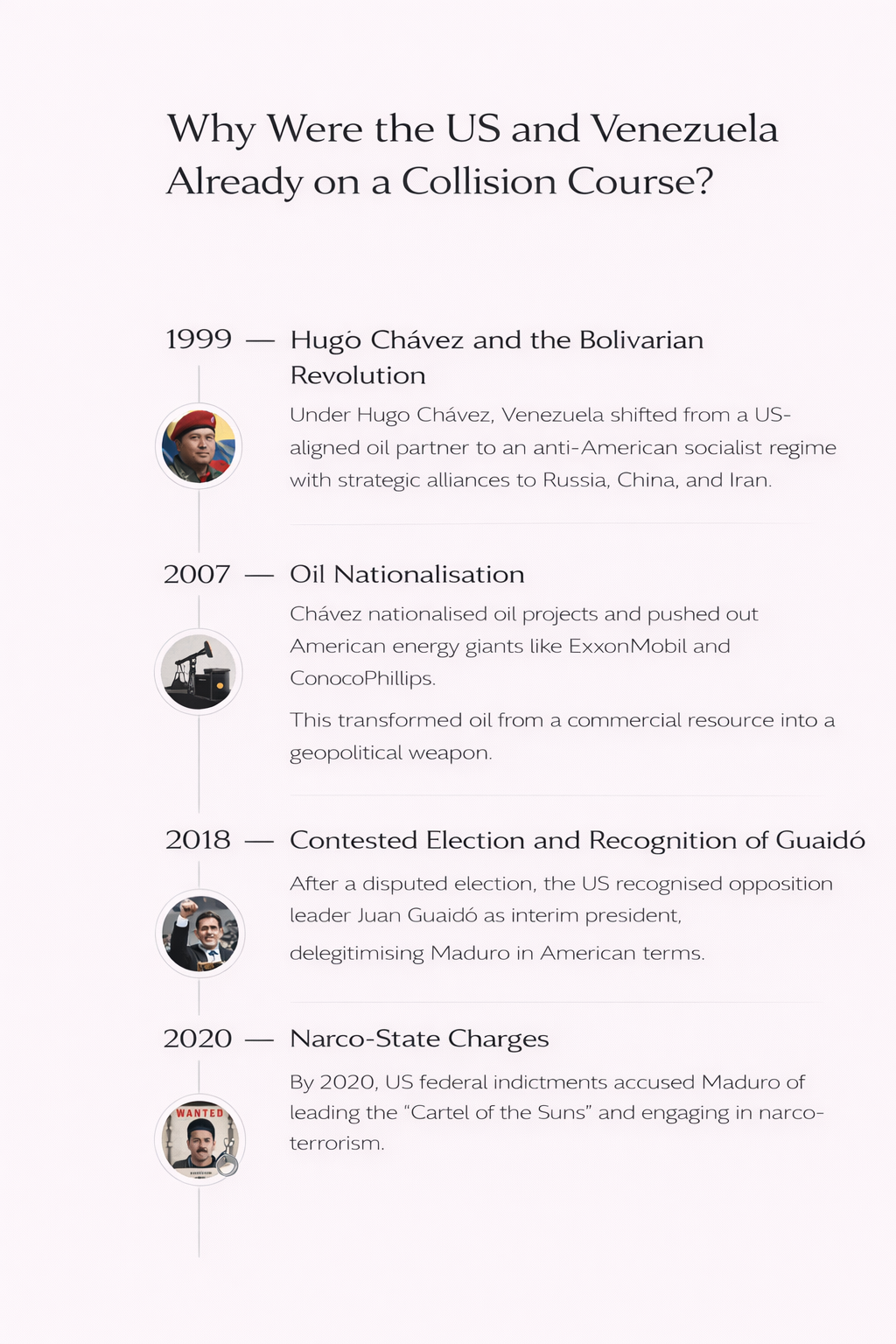
International Law Debate: Was the US action legal?
Violation of Sovereignty
Article 2(4) of the UN Charter prohibits the use of force against territorial integrity.
The US did not obtain UN Security Council authorisation. Many legal scholars argue this qualifies as unlawful use of force.
Sovereign Immunity Question.
International law traditionally grants sitting heads of state immunity.
The US argued Maduro was no longer legitimate and thus not protected. This interpretation remains deeply contested.
Self Defence Justification.
The US framed drug trafficking as an “armed attack” on American citizens.
Critics argue that expanding “self-defense” to criminal networks redefines international war doctrine.
Oil Geopolitics: The bigger picture.
Venezuela possesses the world’s largest proven oil reserves — over 300 billion barrels. Strategically, the operation:
Removes a Russia-China ally from the Western Hemisphere.
Reopens access for Western energy companies.
Alters global oil supply dynamics.
Energy security and geopolitical competition intersect sharply here.
Global Response: A divided world
US allies welcomed the action.
Russia and China condemned it as aggression.
Latin American neighbours expressed fear of regional instability.
EU adopted a cautious middle ground.
The event deepened global polarisation.
India’s Position: Strategic Autonomy
India issued a measured response:
Called for restraint and peaceful resolution.
Avoided condemning the US outright.
Did not endorse unilateral intervention.
Focused on humanitarian concerns.
This reflects India’s long-standing doctrine of strategic autonomy.
For UPSC Mains, this is a textbook example of balanced diplomacy.
What does this crisis tell us about the world order?
The Venezuela Crisis 2026 raises a fundamental question:
Are we still operating under a rules-based international order, or are we entering an era where power overrides procedure?
The incident challenges:
UN institutional authority
Sovereignty norms
The balance between law enforcement and warfare
The meaning of multipolarity
The Afghanistan–Pakistan conflict is rooted in a colonial-era fault line—the Durand Line (1893), which split the Pashtun heartland without considering ethnic realities. While Pakistan treats it as a settled international border, Afghanistan has never formally recognized it, making this dispute the core structural tension since 1947.
In recent years, this long-standing issue has escalated into a modern security crisis. The trigger is the rise of the Tehrik-i-Taliban Pakistan (TTP)—a militant group targeting the Pakistani state but allegedly operating from Afghan soil. Pakistan accuses the Afghan Taliban of providing safe havens, while the Taliban denies responsibility. This has led to cross-border airstrikes, artillery exchanges, and a near “active conflict zone” along the border (2025–26).
A major paradox defines the situation: Pakistan once supported the Taliban for “strategic depth,” but now faces blowback, as the same ecosystem fuels instability within its own borders. At the same time, ethnic nationalism (Pashtun identity) has proven stronger than religious unity, preventing even the Taliban from accepting Pakistan’s position.
The conflict also has a strong geopolitical layer:
Pakistan fears strategic encirclement by India (east) and Afghanistan (west).
India has pursued soft power diplomacy, investing in infrastructure, education, and humanitarian aid.
China and Iran view Afghanistan through economic and connectivity lenses (CPEC expansion, Chabahar route).
Beyond military tensions, the crisis is deeply humanitarian and economic:
Border closures (Torkham, Chaman) have weaponized trade, crippling Afghanistan’s economy.
Pakistan’s mass deportation of Afghan refugees has created a new humanitarian emergency.
Afghanistan is attempting to reduce dependence on Pakistan by shifting trade routes to Iran and Central Asia.
Core Insight | Way Forward | Bottom Line
Core Insight- This conflict is no longer just about borders—it reflects a shift from “strategic depth” to “strategic deadlock”, where historical grievances, militant networks, and regional rivalries intersect.
Way Forward-
Institutionalized border management instead of ad-hoc conflict
Separating trade from security politics
Regional counter-terror cooperation
Humane refugee policies
Connectivity-led approach (TAPI, Chabahar)
Inclusive governance in Afghanistan
Bottom Line- Stability in the region will not come from fences or firepower, but from economic interdependence, regional cooperation, and political inclusion. For India, this presents both a security challenge and a strategic opportunity to deepen its role as a developmental partner.